

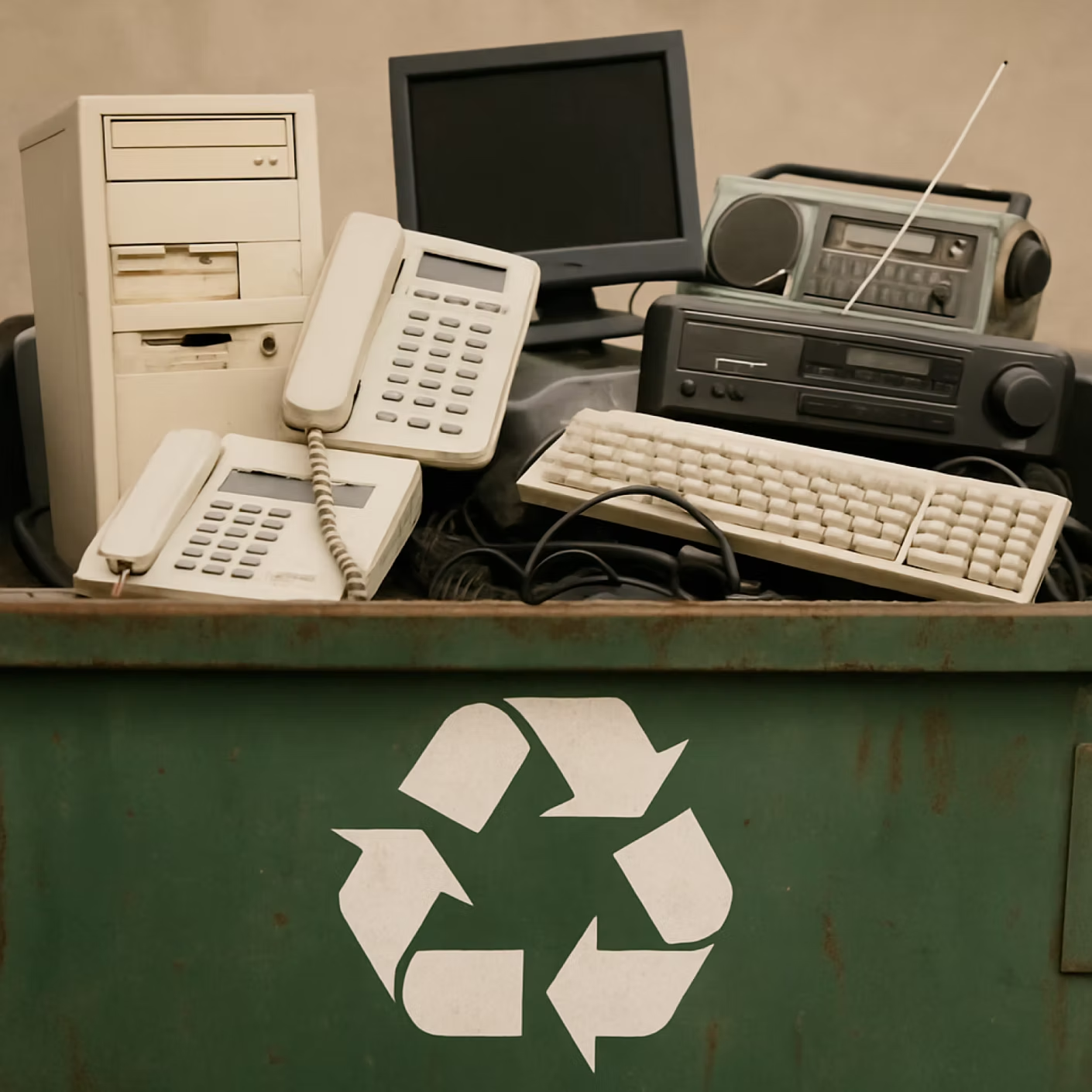
Monitor recycling begins by sorting retired displays by technology, before any unit is dismantled. A CRT (cathode-ray tube) monitor or television is built around a heavy glass picture tube that contains lead. Flat-panel LCD and LED displays have no tube, but older LCDs rely on fluorescent backlight lamps that contain mercury. Every display type also contains circuit boards, plastics and metals that can be recovered.
Sorting up front keeps leaded glass and mercury lamps out of general electronics processing. It also leads to more accurate quotes, because a pallet of CRTs weighs and handles very differently from a pallet of flat screens.
| Display type | Key recycling concern | Our handling |
|---|---|---|
| CRT monitors and televisions | Leaded glass in the picture tube; heavy and fragile | Counted separately, kept upright and sent to a CRT glass stream |
| Older LCD monitors with fluorescent backlights | Mercury inside the backlight lamps | Transported intact so the lamps stay unbroken |
| LED-backlit LCD monitors and TVs | Circuit boards, plastics, metals and the glass panel | Standard flat-panel display stream |
| Cracked or broken screens of any kind | Loose glass and potential release of lead or mercury | Reviewed and packed separately ahead of pickup |
California's Department of Toxic Substances Control (DTSC) regulates discarded displays through its electronic hazardous waste and universal waste rules. Because of their lead content, CRTs and CRT glass are covered by those rules, and lamps containing added mercury are classed as universal waste. None of these items may be thrown in the trash, and the business discarding them stays responsible until they reach an authorized destination.
Our guide to e-waste in California explains the broader requirements for businesses.
- Businesses and IT departments swapping out desktop monitors during a computer refresh.
- Schools, public agencies and facilities teams clearing out CRTs that have been stored for years.
- Property managers dealing with monitors and TVs left behind by tenants.
- Organizations combining mixed CRT, LCD, LED and television inventories.
We collect monitors from businesses and organizations, and businesses may also drop them off at our facility at 3921 Pell Circle, Sacramento, CA 95838. We do not offer residential services; households can recycle electronics through our sister company, Secure Recycle, at the same address.
A small amount of preparation keeps the load intact and the quote accurate:
- Count CRTs and flat panels separately, and record screen sizes where possible.
- Keep CRTs upright on a pallet or another stable surface; loose stacking is the most common reason tubes crack.
- Photograph cracked or damaged screens before moving them, and keep them apart from intact units.
- Leave flat panels whole, with the backlight and panel in place.
- Check all-in-one computers and smart displays for internal storage, which requires secure data destruction before recycling.
One broken tube can change the packaging and handling plan for the entire load, so let us know about any damage before pickup day.
| Area | What to confirm | Red flag |
|---|---|---|
| Display sorting | CRTs and flat panels tracked and processed in separate streams | All screens priced and handled as one mixed e-waste load |
| Damaged units | A written procedure for broken tubes and cracked panels | Broken screens refused on pickup day with no alternative |
| CRT glass | A clear explanation of where leaded glass goes after collection | No information about the downstream route |
| Documentation | Counts or weights by display type plus a certificate of recycling | Paperwork that groups CRTs with other electronics |
| Management systems | Valid ISO 9001, ISO 14001 and ISO 45001 certificates | Logos with no certificates behind them |
Our ISO 45001 safety management system covers the lifting and glass-handling risks that come with heavy CRTs, while ISO 14001 environmental management governs how the separated glass, boards and plastics are sent downstream.
| Component | Usual scope |
|---|---|
| Identification | Display technology, quantity, screen size, condition and damage review |
| Collection | Palletizing, labor and pickup for businesses, or drop-off at our facility |
| Separation | CRT glass, flat-panel components, circuit boards, plastics and metals |
| Processing | Recycling through the approved route for each display type |
| Documentation | Quantity, weight and a certificate of recycling |
For a business pickup, send us counts by display type, screen sizes, any damage, the pickup address, access details such as stairs, elevators or a loading dock, and the documents you need. Request a quote or call (916) 339-3676. We schedule monitor pickups for businesses throughout California, depending on route and project scope, and can combine them with other business electronics recycling at the same location.
Once processing is complete, you receive the recycling records agreed in the scope, typically quantities or weights by display type and a certificate of recycling. Serial-level reporting is available when it is part of the scope. Any environmental figures we provide are based on documented processing weights.
Monitor recycling pickups are available across California and in parts of Nevada, including Sacramento, Bakersfield, Fresno, Modesto, Clovis, Carmichael, Rocklin, Placerville, Orinda, Pleasant Hill, Los Banos, Goleta, and Sparks, NV. Check the complete Service Areas list to confirm coverage in your location.

Reviews
A little bit off the beaten track in Natomas, but Modern Waste quickly and efficiently helped me recycle my broken Lithium Iron Phosphate batteries at a reasonable $/lb fee (Sac county e-waste will not accept these items). Ramiro and Vincent were very friendly and helpful.

Chris was awesome! He came in and picked up all of the e-waste we had ready for him. He was polite and professional throughout the entire process. He handled the equipment with care, including the site equipment that was already in place. I am very happy with his service and appreciate the great job he did.

Aaron and Vincent were awesome, excellent customer service!

Great guys, excellent customer service, highly recommend!

Polite, quick and easy.

Chris from modern waste was the most outstanding respectful person I ever met my life when he was done he offered to sweep the floors. He offered so much even though he was limited on time he went out of his way and he’s over beyond best guy I ever met thank you so much for your service services Dan ITG.

We have answers.

We organize CRT and flat-panel monitor recycling as a documented six-step workflow. The exact equipment, schedule, and reporting fields are adjusted to the customer's material stream and compliance needs.
- Equipment: We provide or specify the containers, carts, pallets, labels, or other collection equipment needed for the approved material.
- Training: We explain what belongs in each container, how to identify special items, and which materials must remain separate.
- Pick-up: Our team coordinates the business collection or accepts an approved facility drop-off under the agreed schedule.
- Tracking: We record the load and agreed data points, such as material type, weight, serial numbers, dates, or customer-specific fields.
- Processing: We triage, wipe, shred, dismantle, recycle, recover, or route materials according to the approved disposition plan.
- Reports: We issue the applicable recycling or destruction certificates and processing reports for accountability and audits.
Planning the scope before the first collection keeps these steps connected. It also prevents equipment, data media, batteries, and other regulated materials from entering the wrong workflow.
CRT equipment is segregated from flat-panel displays and handled through an approved recycling path appropriate to its regulated glass and electronic components. Units are tracked and packaged to reduce breakage, while damaged displays receive separate review. Customers should disclose broken tubes, contamination, or unusual industrial monitors before collection.
We define accepted materials, custody points, treatment, downstream path, exceptions, and required records before the job begins.
Certification is useful because it connects service claims to audited management systems and documented operating controls. Our current framework combines quality, environmental management, and worker-safety standards.
- ISO 9001:2015 for documented and repeatable quality-management processes.
- ISO 14001:2015 for environmental-management controls and continual improvement.
- ISO 45001:2018 for occupational health and safety management.
The certification set does not replace a project scope, but it gives procurement and compliance teams a stronger basis for reviewing handling, downstream accountability, and reporting. Customers should still define the material, data, access, and documentation requirements for each job.
Certifications support a controlled process, but they do not transfer every legal or operational responsibility from the customer. The written scope should identify the exact materials, facility duties, and documentation required for the project.
Start a CRT and flat-panel monitor recycling request by describing the material, location, quantity, condition, access, deadline, and required documentation. Our Sacramento operation coordinates business service across California, subject to route availability and project scope.
- Prepare an inventory or representative list with quantities, labels, models, dimensions, and photos.
- Identify sensitive data, hazardous characteristics, damage, special access, or deinstallation requirements.
- Define the approved treatment, pickup or drop-off preference, timeline, and reporting fields.
- Submit the quote request so our team can review acceptance, logistics, exceptions, and pricing.
- Approve the written scope and prepare the site or material according to the confirmed instructions.
Do not wait until collection day to disclose unknown, damaged, leaking, data-bearing, unusually heavy, or regulated items. Early disclosure allows the correct containers, crew, transport, and downstream process to be assigned.
Our CRT and flat-panel monitor recycling offering is assembled around the customer's approved material and required outcome. It can connect collection, secure handling, treatment, responsible recycling, and closeout records in one coordinated scope.
| Service element | Typical scope |
|---|---|
| Identification | Display technology, quantity, size, condition, and special handling review. |
| Collection | Packaging, palletization, labor, pickup, or approved drop-off planning. |
| Separation | CRT glass stream, flat-panel components, circuit boards, plastics, and metals. |
| Processing | Responsible recycling through the appropriate approved pathway. |
| Documentation | Agreed quantity, weight, and recycling records. |
The proposal states which elements are included and which conditions require separate approval or pricing. Customers should verify the final scope rather than assume that every possible material or report is included automatically.
Monitor recycling separates retired displays into appropriate processing streams based on technology and condition. CRT monitors and televisions contain leaded glass and require different handling from LCD, LED, and other flat-panel displays, which may contain lamps, circuit boards, plastics, and metals. Identifying the display type before pickup supports safe packaging and accurate pricing.
A professional CRT and flat-panel monitor recycling project defines what is accepted, who authorizes release, how material is collected, what treatment will be used, and which records will be returned. That makes the service an accountable disposition process instead of simple removal.
We confirm the scope before scheduling so equipment, data, regulated components, and documentation follow the correct path from the start.
Trust in CRT and flat-panel monitor recycling comes from trained field work, clear custody, documented processing, and records that match the approved scope. We connect collection and treatment rather than treating pickup as the end of the service.
Technician perspective: Our technicians recommend counting CRT and flat-panel units separately and photographing any damaged screens before they are moved. CRTs should remain upright and stable, and loose stacking should be avoided because one broken tube can change the handling plan for the entire load.
That preparation reduces exceptions and protects both the customer's operations and the integrity of the final report. Any material outside the approved scope is reviewed before it moves forward.
A structured CRT and flat-panel monitor recycling program closes the gaps that appear when obsolete material is stored indefinitely or released without a defined treatment plan. It assigns responsibility for custody, safety, processing, and closeout.
- Leaded CRT glass entering an unsuitable waste or recycling stream.
- Broken displays creating glass, dust, and handling hazards.
- Large mixed inventories consuming storage and complicating compliance records.
The result is a traceable business process with fewer last-minute surprises. It also gives facilities, IT, safety, and compliance teams a common record of what left the site and what happened next.
Before ordering CRT and flat-panel monitor recycling, create a practical scope that separates routine logistics from data, safety, environmental, and facility decisions. The inventory can be preliminary, but unusual items and unknowns should be visible before scheduling.
- CRT, LCD, LED, television, industrial display, or mixed equipment type.
- Unit count, screen size, weight, condition, and broken-glass risk.
- Stairs, elevators, docks, palletization, labor, and pickup access.
- Asset labels, serial reporting, and required recycling documentation.
Share photos and the required completion date with the quote request. We can then confirm acceptance, identify exclusions, and choose the correct collection and processing plan.
Choose a CRT and flat-panel monitor recycling provider by asking how the proposed workflow handles the actual material, risks, and records. A useful proposal explains more than collection date and price.
| Criterion | What to verify | Warning sign |
|---|---|---|
| Service fit | A documented plan specific to CRT and flat-panel monitor recycling | Generic hauling with no material review |
| Certifications | Current ISO management-system certificates | Logos without verifiable scope or dates |
| Security and safety | Defined custody, hazards, trained personnel, and exception handling | No written controls for sensitive or unusual items |
| Processing | Clear treatment and downstream pathway for every approved material | Destination or method is not explained |
| Reporting | Agreed certificates, inventory fields, and delivery timing | Documentation discussed only after pickup |
Ask for current certification evidence and make the provider explain the exception path for material that cannot be processed as expected. That discussion shows whether the service is operationally ready for the project.
After processing, the customer receives the recycling documentation specified for the job, such as quantities, weights, and a certificate of recycling. Serial-level reporting is available only when it is included in the scope. Environmental claims are tied to documented processing rather than estimated from the number of monitors alone.
Closeout timing depends on processing, downstream records, and the level of inventory detail requested. Ask for document names and delivery expectations in the proposal so internal stakeholders know what evidence will be available.
Any discrepancy should be resolved against the pickup ticket, inventory, and approved change record before the project is closed.
CRT and flat-panel monitor recycling is intended for organizations that need more control than an ordinary trash or scrap pickup can provide. The need may come from data sensitivity, safety, regulated components, project scale, or audit requirements.
- Businesses and IT departments replacing desktop monitors or display systems.
- Schools, public agencies, and facilities clearing stored CRT equipment.
- Organizations consolidating mixed CRT, LCD, LED, and television inventories.
A project does not need to be large to justify a documented service. A small load with confidential data or special handling can carry more risk than a large load of ordinary recyclable material.
We provide business monitor collection and recycling from our Sacramento operation across California, subject to route and project scope. Mixed electronics can be coordinated with batteries, data destruction, and asset reporting when needed. The load is planned by display type so CRTs and flat panels do not enter the same undifferentiated workflow.
The practical advantage is fewer disconnected handoffs and a clearer audit trail from collection through final disposition. Service availability, timing, accepted materials, and reports remain project-specific and are confirmed before scheduling.
Customers receive a plan sized to the actual risk and logistics instead of a generic promise.