
Published August 27, 2026 · 12 min read · Updated September 27, 2026
E-Waste in California: Definition, Examples, and Business Responsibilities
E-waste isn't one legal category. Here's how California businesses should classify equipment, spot hazardous and data-bearing devices, and build a disposal process that holds up to scrutiny.
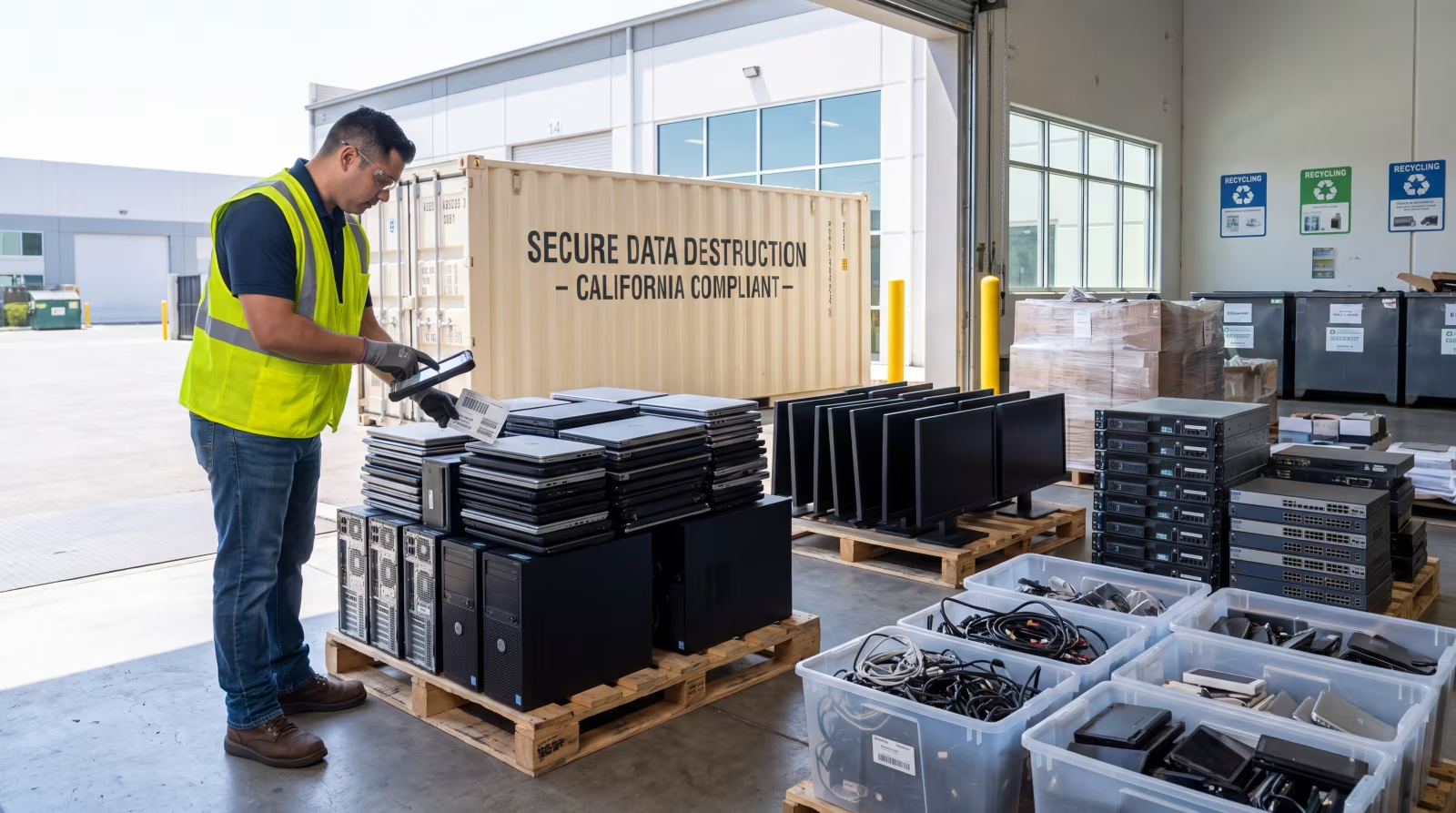
Electronic waste is not one uniform legal category. A retired monitor, a working laptop offered for resale, a printer with an internal drive, and a damaged battery-powered device may follow different rules even though people call all of them “e-waste.” California businesses need a process that identifies the equipment, checks for hazardous components and stored data, selects an authorized disposition route, and preserves evidence after collection.
Modern Waste Solutions has provided electronic waste recycling, data destruction, equipment pickup, tracking and reporting to California organizations since 1999. This guide answers what e-waste is in California, which equipment belongs on a business list, and what the business must settle before the handoff: ownership, legal holds, data, batteries, condition and inventory, so the recycler receives a controlled load instead of an unidentified mix.
E-waste is a practical term for unwanted electrical and electronic equipment. It can include consumer products, business devices, infrastructure hardware, accessories, and components that are obsolete, damaged, surplus, returned, or no longer supported. California does not use a single broad definition that makes every unwanted electronic product legally identical. CalRecycle states that the term is loosely applied to unwanted consumer and business electronic equipment and that some, but not all, e-waste is hazardous.
Legal treatment depends on the device and its condition. Some electronics contain leaded glass, mercury lamps, batteries, circuit-board constituents, or other materials that may make the discarded equipment hazardous under California rules. A nonfunctioning cathode-ray-tube monitor is not evaluated the same way as a functional keyboard. A device intended for legitimate reuse may follow a different pathway from an item discarded for dismantling. A battery embedded in a product can also trigger separate collection, fire-safety, or transportation controls.
Keep three terms apart:
- Unwanted electronics describes the business decision that equipment is no longer needed.
- Electronic hazardous waste describes discarded electronic material that meets applicable hazardous-waste criteria or is regulated as such.
- Universal waste is an alternative management framework for specified hazardous wastes, designed to support collection while preserving controls for storage, transport, and destination.
The California DTSC electronic hazardous-waste guidance is the primary starting point for device-specific obligations. CalRecycle administers the Covered Electronic Waste Recycling Program, which applies to covered devices and supports approved collection and recycling. Those programs overlap in subject matter but serve different regulatory functions.
From an operational perspective, a business should classify equipment through five questions: Who owns it? Does it work? Does it contain data? Does it contain a battery, lamp, refrigerant, radiation source, or other regulated component? What is the intended disposition? The answer should be recorded before the device leaves secured control.
A good internal definition is therefore: e-waste is electrical or electronic equipment the organization has removed from active use and must evaluate for reuse, data treatment, hazardous components, regulated handling, and final disposition. This definition is broad enough for inventory control without pretending that every item has the same legal status.
California businesses should build an asset list that is wider than desktop computers. Modern offices, warehouses, clinics, retail locations, and industrial facilities use electronics in nearly every function. The list should include the main device, detachable components, embedded batteries, storage media, and accessories. Items should then be separated by data risk, condition, and special handling needs.
| Equipment category | Common examples | Important handling question |
|---|---|---|
| Computers and storage | Desktops, laptops, servers, external drives, storage arrays | Has data been retained, sanitized, or approved for destruction? |
| Displays | CRT, LCD, LED and OLED monitors, televisions, smart displays | Is the screen damaged, and does the unit contain lamps or integrated storage? |
| Print and imaging | Printers, copiers, scanners, fax machines, production units | Is there an internal drive, toner, lamp, or leased-equipment obligation? |
| Mobile and handheld | Phones, tablets, scanners, radios, point-of-sale devices | Is the battery intact and are accounts, credentials, or device locks removed? |
| Network and telecom | Switches, routers, firewalls, access points, PBX equipment | Have configurations, certificates, passwords, and keys been removed? |
| Peripherals | Keyboards, mice, docking stations, headsets, webcams, cables | Can items be reused, or should they be consolidated for material recovery? |
| Battery-embedded products | Tools, small appliances, toys, test equipment, portable devices | Must the battery be removed or managed with the product? |
| Specialized electronics | Medical devices, laboratory equipment, UPS systems | Are there contamination, radiation, high-voltage, data, or manufacturer controls? |
Not every electrical item belongs in the same e-waste container. Loose batteries should be segregated by chemistry and condition. Refrigerated appliances may require refrigerant management. Smoke detectors, lamps, mercury devices, capacitors, pressurized components, and equipment containing liquids can require separate approval. Certain medical or industrial devices need a project review rather than routine office-electronics pickup.
Ownership also matters. Leased copiers, telecom hardware, and service-provider equipment may need to be returned under contract. A business should not recycle an item merely because it is physically located on its premises. Similarly, equipment subject to a legal hold, investigation, warranty claim, recall, or insurance claim should not enter disposition until the responsible owner approves release.
California’s covered-device program does not mean that every item listed above is a covered electronic device eligible for the same program treatment. CalRecycle’s electronic-waste page links to current covered-device, fee, collector, and recycler information. As of January 1, 2026, SB 1215 added covered battery-embedded products to the Covered Electronic Waste Recycling Program, with implementation requirements that depend on product and participant role. Businesses should verify current lists rather than relying on a static memory of what was covered before 2026.
The practical list should therefore have four outcomes: routine electronics, data-bearing electronics, separately managed components, and exception items requiring approval. That classification prevents batteries, lamps, high-voltage equipment, or unknown material from disappearing into a mixed pallet.
E-waste creates several risks at once. The environmental issue is the most visible: some discarded electronics contain lead, mercury, batteries, and other constituents that should not be released through breakage, uncontrolled dismantling, or disposal. California specifically treats certain nonfunctioning CRTs and mercury-containing display components as hazardous waste. When electronics are managed through qualified reuse and recycling channels, recoverable metals, glass, plastics, and components can remain in productive use instead of being lost.
For a business, data exposure can be more immediate than material value. Computers, servers, phones, printers, copiers, network devices, laboratory instruments, and medical systems may retain files, credentials, address books, cached images, configuration data, or customer information. Deleting a file or performing a factory reset does not automatically prove that storage media was sanitized. A disposition program needs a method decision, validation, and a record tied to the asset.
Battery fire risk is another operational concern. Lithium batteries can remain energetic after the device is obsolete. Crushing during waste collection or compacting can initiate a short circuit and thermal runaway. Damaged, swollen, leaking, recalled, or overheated units require isolation and specialist review. Mixing batteries with office electronics also makes safe packaging and transportation harder.
| Risk angle | Business consequence | Program response |
|---|---|---|
| Hazardous constituents | Regulatory exposure, cleanup, rejected loads | Identify device and components; use approved destinations |
| Stored data | Breach, contractual claims, loss of trust | Inventory data-bearing devices and apply a verified sanitization method |
| Lithium batteries | Heat, fire, toxic gas, transport incident | Inspect, segregate, protect terminals, and escalate damage |
| Illegal or uncontrolled disposal | Fines, reputational harm, no proof of disposition | Maintain chain of custody and certificates |
| Lost material value | Higher disposal cost and unnecessary resource demand | Test for reuse and route remaining material to responsible recycling |
| Warehouse accumulation | Blocked access, breakage, theft, inaccurate inventory | Set quantity limits, inspections, and recurring pickup schedules |
Communities can be affected when uncontrolled processing exposes workers or nearby residents to dust, fumes, broken glass, fire, or contaminated material. Export and downstream practices matter as well: handing equipment to an intermediary does not guarantee that every fraction reaches a responsible destination. EPA recommends certified electronics recyclers as one tool for evaluating environmental, worker-safety, data-security, and downstream controls.
The economic problem is not solved by choosing the lowest pickup price. A weak route can create hidden costs through data incidents, employee time, rejected shipments, lost resale value, emergency cleanup, or missing audit evidence. A stronger program treats electronics as managed assets until reuse, sanitization, recycling, and final reporting are complete.
California’s electronics framework combines hazardous-waste rules, the Electronic Waste Recycling Act, the Covered Electronic Waste Recycling Program, retail fees, and product-specific requirements. A business does not need to memorize every statute, but it must know which role it occupies: purchaser, generator, handler, collector, recycler, retailer, or manufacturer. Different duties attach to different roles.
The Electronic Waste Recycling Act established a system for certain covered electronic devices and created the California recycling fee collected at retail on covered sales. CalRecycle explains that the fee has applied to certain devices sold in California since January 1, 2005 and links to current fee and device information. The fee supports the state program; paying it at purchase does not authorize a business to discard the device in ordinary trash at end of life.
Covered electronic waste collectors and recyclers participate under program requirements and may receive recovery and recycling payments for eligible material. DTSC separately regulates hazardous-waste handling and recycling. Businesses selecting a vendor should therefore ask which entity receives the equipment, which authorizations or certifications apply, and whether any broker or downstream facility participates in the actual processing.
An important current change is SB 1215. CalRecycle states that, effective January 1, 2026, covered battery-embedded products were added to the Covered Electronic Waste Recycling Program. Manufacturer notices, retailer obligations, product lists, fee implementation, and collection pathways may depend on the specific product and date. SB 1215 is enacted law, and its implementation details still depend on current agency guidance.
| Requirement area | What a business should verify | Authoritative starting point |
|---|---|---|
| Hazardous electronic waste | Device condition, hazardous components, handler and recycler duties | DTSC electronic hazardous waste |
| Covered devices and program | Current covered-device categories and approved participants | CalRecycle electronic waste management |
| Retail recycling fee | Current products, fee amount, seller duties, and exemptions | CalRecycle/CDTFA current fee pages |
| Battery-embedded products | SB 1215 product lists, dates, notices, and program treatment | CalRecycle SB 1215 guidance |
| Handler operations | Storage, recordkeeping, treatment restrictions, and destinations | DTSC handler and recycler requirements |
Extended producer responsibility is often used broadly in news and marketing. California has enacted product-stewardship and producer-responsibility laws for specific product categories, but a business should not assume that every electronics proposal or industry initiative is final law. Confirm the statute, effective date, implementing regulations, covered product, responsible party, and current agency guidance before changing policy.
Preparation begins with an inventory, not a loading dock. The business should identify each asset or homogeneous lot, confirm ownership, check legal holds, classify data, note batteries or special components, and select reuse, sanitization, destruction, or recycling. This prevents the recycler from making decisions the business has not authorized.
- Create the release inventory. Capture asset tag, serial number when required, device type, location, owner, condition, data status, and intended disposition.
- Identify data-bearing devices. Include drives in printers, copiers, network hardware, storage arrays, medical systems, and smart devices, not only computers.
- Resolve data and legal holds. Obtain authorization for reuse, sanitization, or physical destruction. Preserve records that must be retained.
- Inspect batteries and exceptions. Separate loose batteries and flag swollen, leaking, damaged, recalled, or high-energy units. Obtain approval for lamps, liquids, oversized equipment, medical devices, or other unusual material.
- Stage securely. Restrict access, protect devices from weather and breakage, segregate reuse candidates, and keep the count stable before transfer.
The releasing employee should verify the vendor, vehicle, date, load, and count or pallet identifiers. Serialized equipment should be scanned or reconciled. The custody record should identify who released and accepted the assets and note discrepancies before the vehicle leaves. If the recycler uses locked carts, tamper seals, or dedicated transport, record the applicable identifiers.
| Control | Evidence |
|---|---|
| Authorized release | Signed pickup ticket or electronic custody event |
| Inventory match | Scan file, count, weight, or pallet reconciliation |
| Data decision | Sanitization/destruction instruction tied to assets |
| Exception handling | Written variance for missing, extra, or damaged material |
| Destination | Named receiving facility and accepted service scope |
Reconcile the recycler’s receiving report against the release inventory. Review exceptions, failed sanitization, missing serial numbers, and devices diverted from the planned disposition. The final package may include a certificate of recycling, certificate of data destruction, serialized sanitization report, weight summary, reuse settlement, and downstream information.
Modern Waste Solutions describes a workflow that includes equipment, training, pickup or drop-off, database tracking, processing, and reports. Its Sacramento facility uses ticketed receiving, triage for data and reuse, treatment, and downstream tracking. The client should still define its required asset detail and certificate fields before pickup so the final report matches audit needs.
An e-waste action plan should convert general recycling intent into assigned work. It needs a policy owner, device classification, data rules, exception path, approved vendor criteria, recurring collection schedule, and audit file. The plan should cover both routine office material and occasional projects such as data-center removals, copier replacements, battery collections, or facility closures.
| Action-plan component | Assigned owner | Required output |
|---|---|---|
| Asset scope | IT asset management and facilities | Device and component list |
| Legal and ownership review | Legal, records, procurement | Release authorization and hold check |
| Data treatment | Information security | Approved method and verification requirement |
| Safety and waste classification | EHS or compliance | Battery, lamp, hazardous component, and exception rules |
| Vendor approval | Procurement and compliance | Authorization, certification, insurance, and downstream review |
| Pickup operations | Site coordinator | Inventory, access plan, and custody record |
| Final reporting | Program owner | Reconciliation, certificates, exceptions, and corrective actions |
Set a regular schedule based on actual accumulation rather than an arbitrary annual event. High-volume sites may need monthly or quarterly service, while smaller offices can use a threshold. The schedule should prevent insecure stockpiles and leave time to resolve data, ownership, and battery exceptions before containers are full.
Practical recommendations include prohibiting informal employee take-home, requiring written approval for donations and resale, and making data treatment a separate decision from material recycling. Audit a sample of serialized assets after each pickup. Verify that certificates identify the right client, date, service, and material; a generic certificate with no link to the released load has limited value.
Modern Waste Solutions serves businesses across California with electronics recycling, secure data destruction, containers, pickup, tracking, and reports. Organizations can review the electronic waste recycling service and request a pickup plan based on equipment, location, data requirements and access conditions. Monitors and TVs have their own page under monitor and CRT recycling.
What is e-waste, in simple terms?
E-waste is electrical or electronic equipment that is no longer wanted: computers, monitors, phones, printers, network gear, battery-powered devices and their parts. Some of it is hazardous under California rules and some is not, which is why each item needs to be classified.
Is all e-waste hazardous waste in California?
No. CalRecycle notes that some, but not all, e-waste is hazardous. Nonfunctioning CRTs and mercury-containing components are examples of material California treats as hazardous waste.
Does paying the California e-waste recycling fee at purchase cover disposal?
No. The fee funds the state's covered electronic waste program. It does not allow a business to put the device in the trash at the end of its life.
Are batteries e-waste?
Batteries are managed separately. Loose batteries should be collected by chemistry and condition, and batteries built into products may need to be removed or flagged before pickup.
Once your equipment is classified, the rest is scheduling. Request a quote with your list and locations, and we will plan containers, data destruction and reporting around it.
- California DTSC: Electronic Hazardous Waste: dtsc.ca.gov/electronic-hazardous-waste
- CalRecycle: Electronic Waste Management: calrecycle.ca.gov/electronics
- Modern Waste Solutions: Electronic Waste Recycling
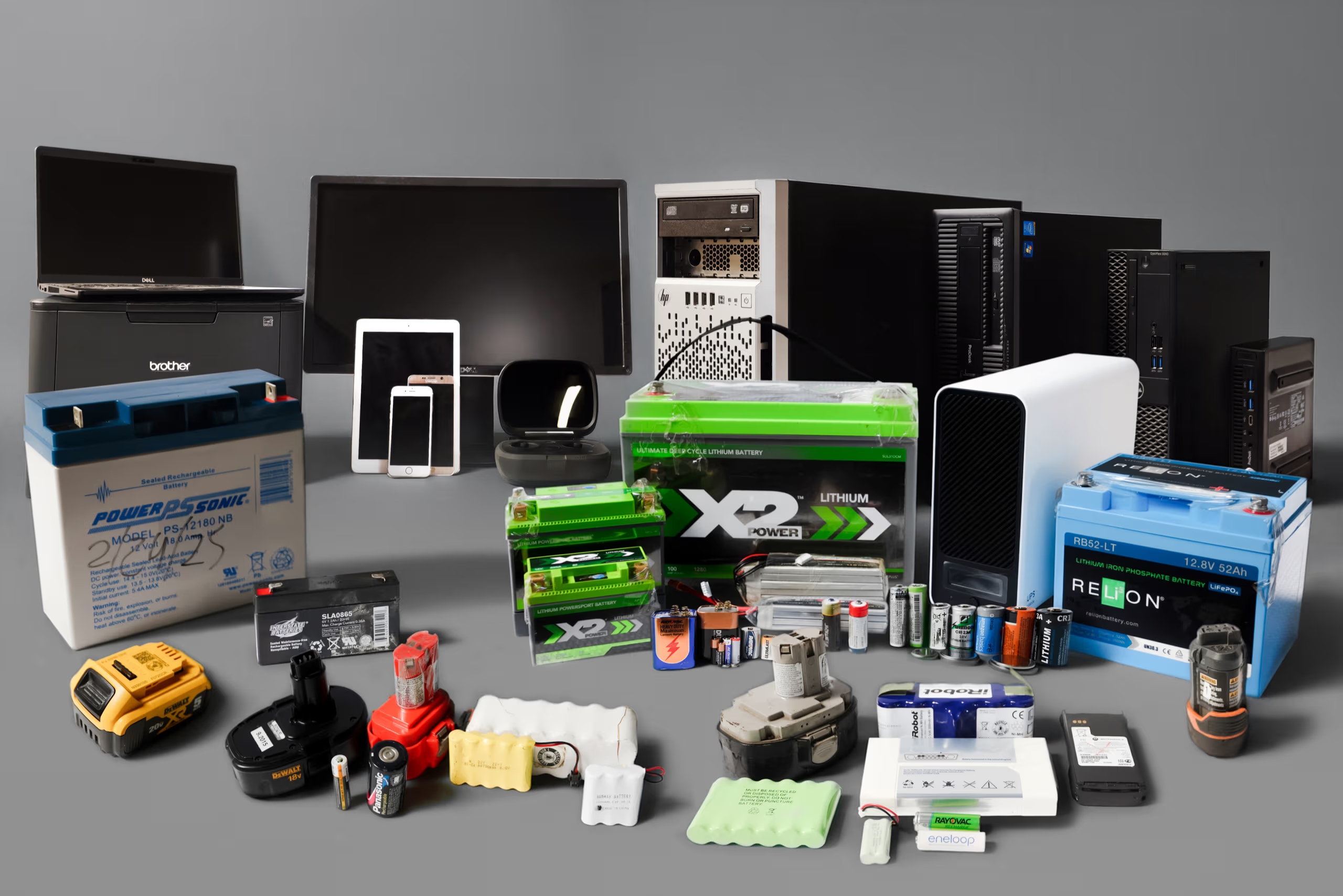

Simplify your compliance and disposal process with bundled recycling services that handle both electronic devices and batteries in one streamlined solution.

Our scheduled, route-based pickups cover all major regions of California—ensuring efficient, on-time service no matter where you operate.
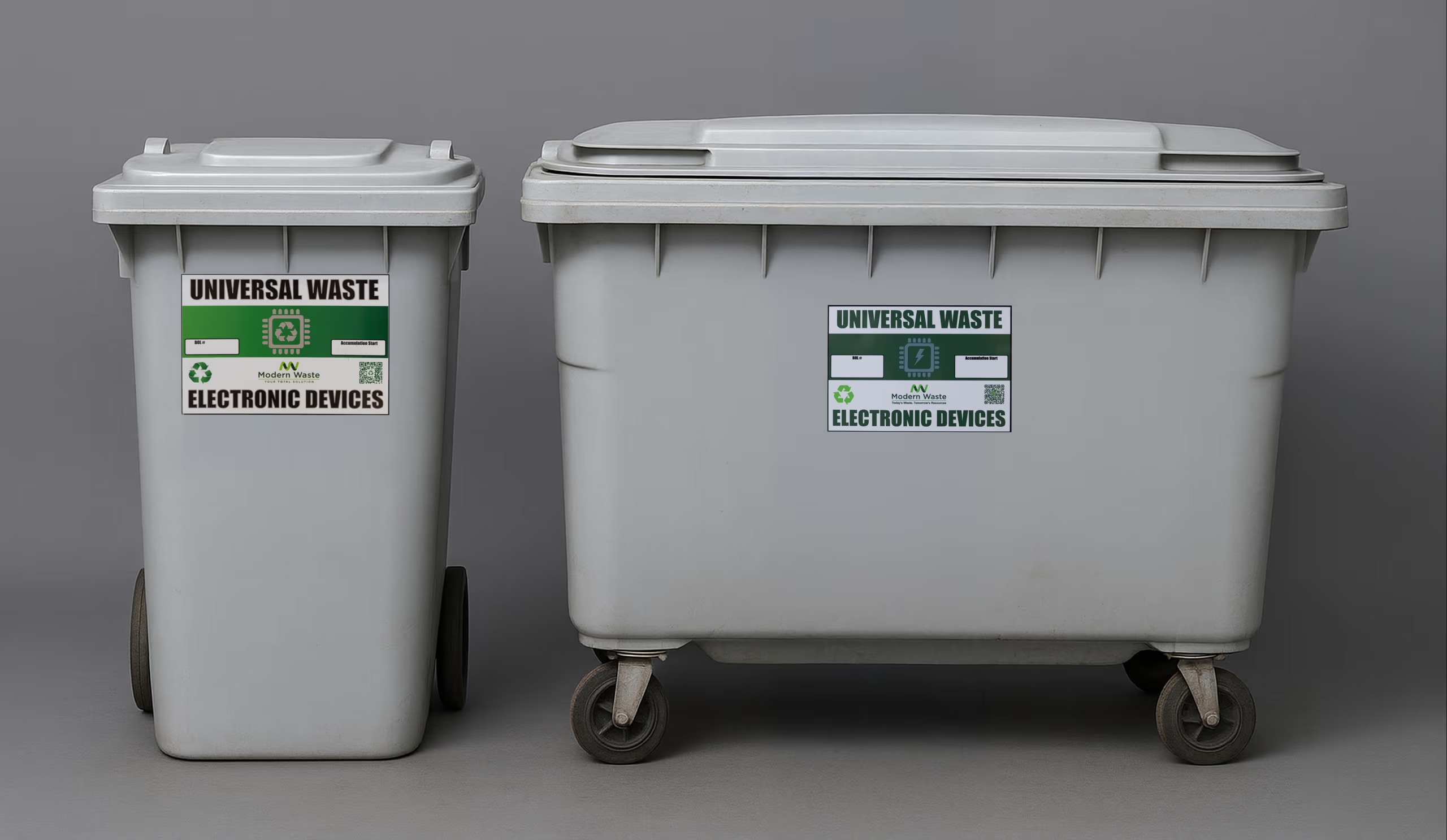
We provide clearly labeled, tamper-resistant containers to ensure safe and compliant collection of electronic waste and batteries at your location.

Modern Waste Solutions has served businesses and communities across California with dependable, environmentally responsible recycling solutions for over two decades.
We adhere to all California and federal regulations, ensuring your electronic and battery waste is managed with complete transparency and environmental responsibility.


Reviews
A little bit off the beaten track in Natomas, but Modern Waste quickly and efficiently helped me recycle my broken Lithium Iron Phosphate batteries at a reasonable $/lb fee (Sac county e-waste will not accept these items). Ramiro and Vincent were very friendly and helpful.

Chris was awesome! He came in and picked up all of the e-waste we had ready for him. He was polite and professional throughout the entire process. He handled the equipment with care, including the site equipment that was already in place. I am very happy with his service and appreciate the great job he did.

Aaron and Vincent were awesome, excellent customer service!

Great guys, excellent customer service, highly recommend!

Polite, quick and easy.

Chris from modern waste was the most outstanding respectful person I ever met my life when he was done he offered to sweep the floors. He offered so much even though he was limited on time he went out of his way and he’s over beyond best guy I ever met thank you so much for your service services Dan ITG.


Data center decommissioning is a controlled change project that retires workloads, infrastructure, and records without interrupting systems that must remain live. Here is the full process, from go/no-go to final reconciliation.
A mature ITAD program connects asset ownership, data security, environmental compliance, logistics, financial recovery, and reconciliation. Here is how the process works, what it costs, and how to evaluate a provider.

IT equipment liquidation converts marketable retired assets into documented financial recovery while routing nonmarketable equipment to responsible recycling. Here is how to decide which path fits each asset.