
Modern Waste Solutions offers secure, ISO-certified on-site hard drive shredding services to help you meet compliance, protect sensitive data, and eliminate liability — all from the convenience of your location.
When it comes to protecting sensitive information, nothing beats witnessing the destruction of your data-bearing devices in real time. On-site shredding ensures total visibility and peace of mind while keeping your devices secure from start to finish.
- Mobile Shredding Unit – We arrive at your facility with state-of-the-art shredding equipment capable of destroying hundreds of drives per hour.
- Chain of Custody – Drives are inventoried and handled by trained technicians with strict security protocols.
- Certified Destruction – After shredding, we provide a Certificate of Destruction for your compliance records and audits.
- Environmentally Responsible Disposal – All shredded materials are recycled through ISO 14001-certified downstream vendors.
- Decommissioning of data centers or IT assets
- Compliance with HIPAA, GLBA, FERPA, and other privacy laws
- Protecting intellectual property and internal business data
- Routine secure disposal of aging storage devices
- Zero Risk of Data Breach – Physical destruction is the most secure method of data disposal.
- Convenient & Fast – No need to transport devices — we come to you and shred on-site.
- Meets Regulatory Standards – Fully compliant with state, federal, and industry-specific data destruction laws.
Contact Modern Waste Solutions today to schedule an on-site shredding appointment and ensure your data is destroyed securely, professionally, and responsibly.
Drives don't have to be shredded on-site. Businesses can have them picked up on a scheduled route or dropped off directly at our Sacramento facility, where they're logged into a secure vault and destroyed on a set schedule. You get the same documentation and Certificate of Destruction either way. See Secure Data Destruction for how facility destruction works.
Depending on your compliance needs and the sensitivity of the data involved, we draw on four destruction methods:
- DBAN – secure data wiping and erasure software that deletes the contents of a hard disk without physically destroying it.
- Degaussing – a strong electromagnetic field erases all magnetically recorded data on the drive.
- Stake Punching – a physical destruction process that crushes hard disk platters and storage units.
- Shredding – drives are shredded into fragments and the resulting material is recycled to base commodities.
We also handle portable-device data destruction — cell phones, USB flash drives, tapes, and CDs/DVDs — using degaussing to eliminate stored data from devices that don't fit a standard shredder.
Not every job needs the same level of documentation. Our service tiers range from basic DBAN erasure included with a standard pickup, up to DOD 5220.22-M and NIST 800-88 compliant destruction with a full Certificate of Destruction listing make, model, method, and serial number for every drive. All of our hard drive destruction services are built to meet or exceed FACTA, HIPAA, PCI DSS, GLBA, and Sarbanes-Oxley requirements, along with the California Information Practice Act (SB1386) — so whichever regulation governs your industry, the documentation is already built into the process.
Ready to schedule a shred? See our On-Site Hard Drive Shredding Program for a fast quote.
On-site hard drive shredding runs throughout California and parts of Nevada, including Sacramento, Bakersfield, Fresno, Modesto, Clovis, Carmichael, Rocklin, Placerville, Orinda, Pleasant Hill, Los Banos, Goleta, and Sparks, NV. See the full Service Areas list for coverage near you.

Reviews
A little bit off the beaten track in Natomas, but Modern Waste quickly and efficiently helped me recycle my broken Lithium Iron Phosphate batteries at a reasonable $/lb fee (Sac county e-waste will not accept these items). Ramiro and Vincent were very friendly and helpful.

Chris was awesome! He came in and picked up all of the e-waste we had ready for him. He was polite and professional throughout the entire process. He handled the equipment with care, including the site equipment that was already in place. I am very happy with his service and appreciate the great job he did.

Aaron and Vincent were awesome, excellent customer service!

Great guys, excellent customer service, highly recommend!

Polite, quick and easy.

Chris from modern waste was the most outstanding respectful person I ever met my life when he was done he offered to sweep the floors. He offered so much even though he was limited on time he went out of his way and he’s over beyond best guy I ever met thank you so much for your service services Dan ITG.

We have answers.

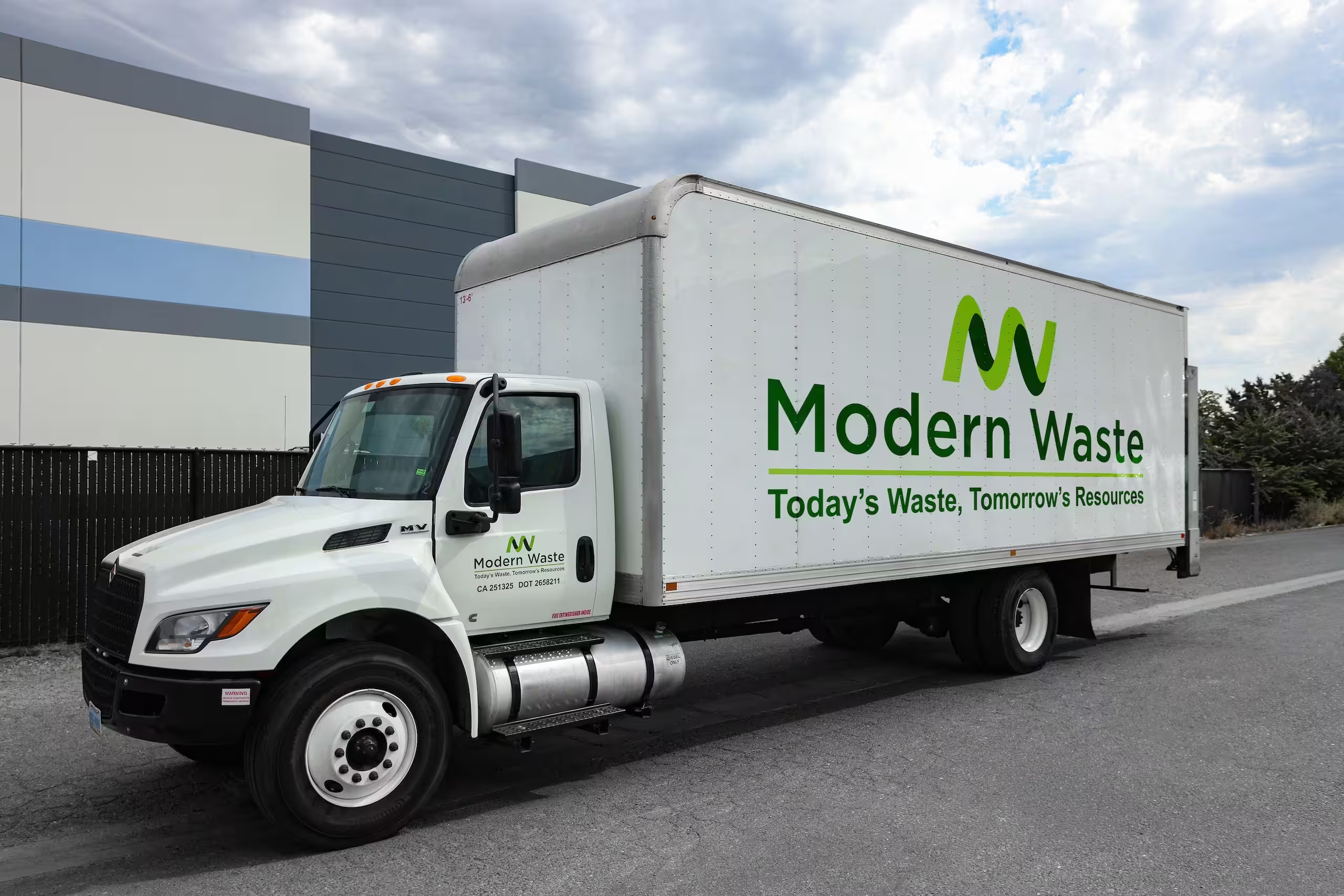
On-site hard drive shredding is a data destruction service where a mobile shredding truck comes directly to a business's facility, rather than the drives being packaged up and shipped to a processing plant elsewhere. A technician arrives with a truck-mounted industrial shredder, inventories the drives on location, and destroys them before anything leaves the property.
For Modern Waste Solutions, that means equipment capable of reducing hundreds of drives an hour to unreadable fragments, right on a loading dock or in a parking area. Because destruction happens on-site, there's no window where drives sit in transit, out of anyone's direct view — a gap that off-site methods can't fully close.
Once shredded, the material still moves through the same recycling path as any other electronic waste, routed to certified downstream partners rather than a landfill. The service scales from a single pallet of retired laptops to a full server-room clean-out, since the truck adjusts to whatever volume is on hand.
In short, it's data destruction a business can watch happen, not one it has to take on faith.
Mobile shredding tends to matter most to organizations that can't afford any gap between "the drive is retired" and "the drive is destroyed." A few groups call on it most often:
- Healthcare providers, where patient records on a retired server or workstation carry HIPAA exposure the moment the hardware leaves a locked room.
- Financial institutions and accounting firms, since account numbers and client financial histories are exactly what identity thieves look for on a resold or discarded drive.
- Government agencies and contractors, which often have documented chain-of-custody requirements that on-site witnessing satisfies more directly than an off-site process.
- IT departments, handling routine hardware refreshes — swapping out laptops, decommissioning server racks, retiring backup tapes.
- Law firms, schools, and any business storing customer data on local drives.
If a drive has ever held something you wouldn't want in a stranger's hands, that's the signal it's time to schedule a shred rather than store it in a closet "for now."
Three risks tend to drive businesses toward on-site destruction specifically, rather than any method that puts distance between a drive and the moment it's destroyed:
- Data breach exposure — a drive that's simply thrown away or handed to an uncertified recycler can often still be read with basic recovery tools, even after a quick reformat.
- Regulatory non-compliance — industries governed by HIPAA, GLBA, FERPA, or similar privacy laws are frequently required to document how and when data was destroyed, and a mailed-off drive with no witness leaves a weaker paper trail than watching a truck shred it on-site.
- Improper e-waste disposal — electronics contain materials that shouldn't go to a landfill, and a service that pairs destruction with certified downstream recycling closes that loop instead of just moving the problem elsewhere.
On-site shredding addresses all three at once — destruction happens in view of the client, the process generates documentation for compliance files, and the shredded material still gets recycled responsibly afterward.
Security on an on-site job comes down to three connected controls — custody, visibility, and verification.
- Chain of custody: each drive is inventoried by a trained technician before it goes near the shredder, creating a documented record of what came in and what was destroyed.
- On-site witnessing: instead of trusting that a sealed box was handled correctly somewhere else, the client (or a designated staff member) can stand next to the truck and watch the drives go in and come out as fragments.
- Verified destruction: the process ends with a Certificate of Destruction documenting exactly what was destroyed and how.
The whole process runs under the company's certification framework — ISO 9001, ISO 14001, and ISO 45001 — meaning the handling, quality, environmental, and safety practices behind the shredding are independently audited rather than self-reported. For a compliance officer who has to prove destruction actually happened, that combination of witnessed action and certified process is what turns "we destroyed it" into something that holds up in an audit.
Trust in this industry comes down to two things: who's actually doing the work, and whether anyone is checking that work. Modern Waste Solutions has operated in California for more than two decades, so the technicians running the shredding truck have handled every kind of drive — spinning-disk units, modern SSDs, tapes, damaged media — not just the easy cases.
On the certification side, the company holds:
- ISO 9001 — quality management.
- ISO 14001 — environmental management.
- ISO 45001 — occupational health and safety.
All four are subject to outside audits rather than self-reporting. Our technicians are trained specifically on chain-of-custody procedures, so the paperwork behind a shredding job matches what actually happened on-site rather than a generic template.
That track record shows up in client feedback too — an average rating of 4.8 built from more than a hundred Google reviews from California businesses. None of that replaces asking direct questions before booking a provider, but a documented history of certified, witnessed destruction is worth checking before handing over a truckload of sensitive drives.
Not every shredding truck on the road offers the same level of documentation or accountability, so it's worth checking a handful of specifics before booking anyone.
| Evaluation Area | What a Reliable Provider Offers | Risk If Missing |
|---|---|---|
| Certifications | ISO 9001, ISO 14001, and ISO 45001, verifiable and current | No independent audit of handling, quality, or safety practices |
| Equipment | Industrial mobile shredder capable of hundreds of drives per hour, on-site | Drives shipped elsewhere, breaking the on-site guarantee |
| On-site verification | Client or staff can watch destruction happen and receive a Certificate of Destruction | No documented proof drives were actually destroyed |
| Insurance & liability | Provider carries commercial insurance covering the on-site work | Client exposed if equipment or property is damaged during service |
| Downstream recycling | Shredded material routed to certified recyclers, not landfill | Environmental and compliance liability shifts back to the client |
A provider that checks all five boxes is handling the job as a documented, audited process rather than a quick pickup with a shredder attached. Modern Waste Solutions builds its on-site shredding around exactly this framework — worth comparing against whatever a prospective provider sends over before scheduling.
A few practical details separate a shredding appointment that goes smoothly from one that runs into last-minute complications.
- Volume — a rough count of drives, or an estimate by pallet, box, or rack, helps determine how much time the truck needs on-site.
- Site access — whether the truck can actually reach a loading dock or parking area near where drives are stored, and any building or parking restrictions during the appointment window.
- Scheduling — businesses with strict operating hours, security clearance requirements, or multiple locations should flag that early so the visit is planned around it rather than a generic time slot.
None of this needs to be exact — a reasonable estimate of volume, a description of the site, and a preferred date range is usually enough to get a firm quote and a confirmed appointment.
Booking an on-site shredding appointment covers more than the shredding itself — it's a full-service process from arrival to final paperwork.
| Included | What It Covers |
|---|---|
| Mobile Shredding Unit | Truck-mounted industrial shredder capable of destroying hundreds of drives per hour, brought directly to your location |
| Chain of Custody | Drives are inventoried and handled by trained technicians under documented security protocols |
| Certified Destruction | A Certificate of Destruction is issued afterward for your compliance records and audits |
| Environmentally Responsible Disposal | Shredded material is routed to ISO 14001-certified downstream recyclers |
In practice, that means a business doesn't need a separate vendor for pickup, a separate one for destruction, and a separate one for recycling — the whole chain is handled by the same crew, under the same paperwork, in a single visit.
Getting a shredding truck to a Sacramento facility starts with a simple request, then follows three steps:
- Contact — call or submit a quote request describing roughly how many drives are involved and the general location.
- Schedule — pick a date and window that works around business hours, loading dock access, and any security or badge requirements.
- Confirmation — once confirmed, the truck arrives on the agreed date, and a Certificate of Destruction is issued before the crew leaves.
Because Modern Waste Solutions is based in Sacramento at 3921 Pell Circle and already runs routes through the local area, confirming a date is usually quicker than booking an out-of-town provider.
There isn't one flat rate for on-site shredding, since the cost depends on a handful of variables that shift from job to job.
- Drive volume — a pallet of a few dozen laptops costs less to process than a full data-center decommission involving hundreds of drives.
- One-time vs. recurring service — businesses that schedule shredding on a regular cycle often see better per-visit pricing than a single ad hoc appointment, since it's planned into a route rather than a special trip.
- Location — distance from the service area's home base adds time and travel cost to a job.
Documentation detail can shift the number too — serial-number-level certificates take more time to prepare than a basic certificate — but volume, frequency, and location are usually the biggest factors. The most reliable way to get an accurate figure is to describe the drive count, location, and whether it's a one-time or recurring need when requesting a quote.
The process is built to be simple to watch and easy to document, from the moment the truck pulls in to the moment it leaves.
- Scheduling — a service date and window are confirmed based on drive volume and site access.
- Arrival — the mobile shredding truck arrives on-site with the shredding unit ready to run.
- Inventory & chain of custody — drives are logged by a trained technician before destruction begins, establishing a documented record.
- On-site shredding — drives are fed into the truck-mounted shredder and reduced to fragments in view of the client.
- Verification — staff can witness the destruction directly, confirming the drives never leave the property intact.
- Certificate & recycling — a Certificate of Destruction is issued, and the shredded material is routed to certified downstream recyclers.
Because every step happens at the client's location, there's no point in the process where a drive is out of sight before it's destroyed — which is really the whole reason to choose on-site over off-site in the first place.
For a Sacramento business, the case comes down to three things working together rather than any single selling point.
- Certified process — ISO 9001, ISO 14001, and ISO 45001 all apply to how drives are handled, shredded, and recycled, backed by outside audits rather than a company's own word.
- Local coverage — based at 3921 Pell Circle in Sacramento and running scheduled routes across the region, so on-site shredding doesn't require booking a specialty out-of-town vendor.
- Reliable turnaround — because the crew already services the Sacramento area regularly, appointments are usually easier to confirm quickly, and the destruction itself typically takes a fraction of a business day.
Put together, that means a Sacramento business gets destruction it can verify, from a provider it doesn't have to chase down, on a timeline that fits around normal operations.
Once the truck leaves, a business is left with more than just empty space where the old drives used to sit.
- Certificate of Destruction — confirms what was destroyed, when, and by what method — the document that matters if a regulator, auditor, or insurer ever asks how sensitive data was handled.
- Compliance documentation — supports a business's own HIPAA, GLBA, FERPA, or similar compliance file, since destruction was witnessed and certified rather than assumed.
- Confirmation of eco-friendly recycling — proof the shredded material was routed through certified downstream recyclers rather than a landfill.
Together, that's a package worth filing away — proof of destruction, proof of compliance, and proof of responsible recycling, tied to a single dated appointment.