
Published August 27, 2026 · 12 min read · Updated September 27, 2026
How Businesses Can Recycle Electronics Securely and Responsibly
Responsible electronics recycling starts with asset control and ends with reconciled records. Here is the full workflow a business can follow, from inventory through final reporting.
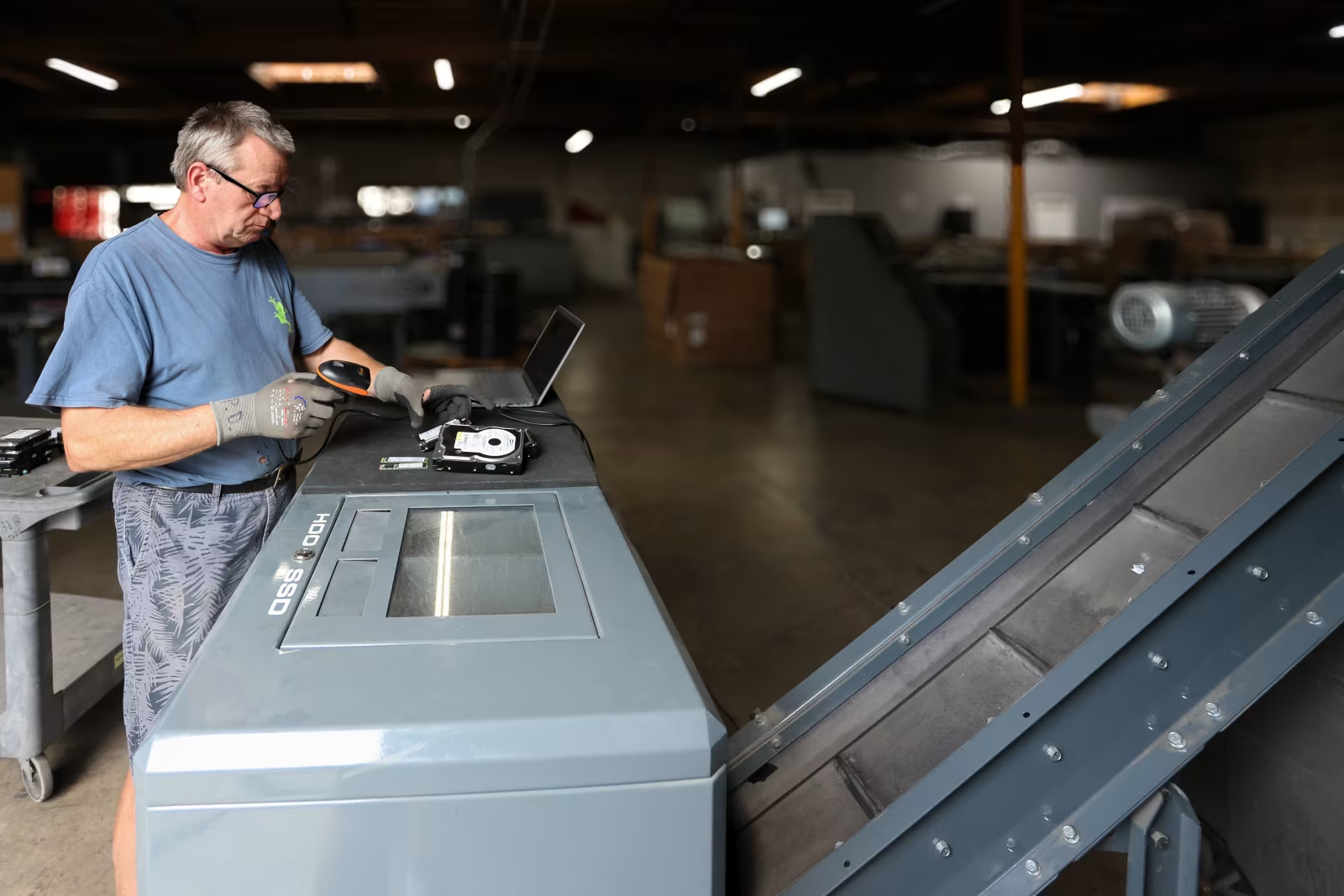
Responsible electronics recycling begins with asset control and ends with reconciled evidence. Between those points, a business must decide which equipment can be reused, how data will be protected, how batteries and hazardous components will be managed, who is authorized to take custody, and what reports will prove final disposition. A pickup alone does not answer those questions.
Modern Waste Solutions has provided electronics recycling, data destruction, collection equipment, training, pickup, tracking, processing and reports to California organizations since 1999. The workflow below shows how a business can recycle electronics with its internal owners and the recycler coordinating early, so security and compliance decisions are made before the equipment reaches the loading dock.
The process should be designed as an asset lifecycle, not as a facilities cleanup. Every stage needs an owner, a decision, and a record. The level of serial-number detail can vary by risk: a pallet of keyboards may be managed by count or weight, while servers and storage devices usually require asset-level reconciliation.
- Inventory the equipment. Record device category, asset tag, serial number where required, location, owner, condition, accessories, and embedded storage or batteries.
- Confirm authority to dispose. Check ownership, lease returns, legal holds, investigation status, warranty claims, and department approval.
- Classify data. Identify storage media and determine whether the asset can leave the site before sanitization. Set the approved Clear, Purge, or Destroy outcome based on policy and risk.
- Triage for reuse. Separate functional, supported equipment with potential value from obsolete, broken, regulated, or uneconomic devices. Do not offer a device for reuse until data treatment and ownership are resolved.
- Prepare and stage. Remove or segregate loose batteries, isolate damaged lithium units, protect screens, secure data-bearing assets, and control additions after the final inventory.
- Transfer custody. Verify the vendor and vehicle, scan or count the load, document seals or container IDs, and obtain a signed custody record.
- Process and reconcile. Compare the recycler’s receiving data to the release inventory and resolve missing, extra, or condition-exception items.
- Close the project. Retain sanitization or destruction records, recycling certificates, reuse settlements, downstream reports, and corrective actions.
| Stage | Primary business owner | Minimum record |
|---|---|---|
| Inventory | IT asset management | Asset or lot register |
| Release approval | Business owner, legal, records | Disposal authorization |
| Data decision | Information security | Approved method and asset scope |
| Safety review | EHS or facilities | Battery and exception log |
| Pickup | Site coordinator | Custody receipt and reconciliation |
| Final reporting | Program owner | Certificates, reports, and exception closure |
For recurring service, standardize intake fields and container rules across sites. For projects, hold a pre-pickup meeting that confirms volume, equipment mix, access, labor, packing, data requirements, and report format. Modern Waste Solutions’ electronic recycling service describes database tracking and certificates as part of its process; the client should specify which assets require serialization before the work begins.
At a controlled receiving facility, the first tasks are identity, custody, and condition. The recycler receives the load, checks documentation, assigns a tracking record, and records count or weight. Serialized assets may be scanned. Differences between the shipping list and the received material should be placed in an exception queue rather than silently corrected.
The load is then triaged. Working devices may be candidates for testing, reuse, resale, or parts harvesting. Data-bearing equipment follows the authorized sanitization or destruction route. Batteries, lamps, toner, CRTs, and other components are separated for appropriate handling. Items that are damaged, leaking, swollen, or inconsistent with the service agreement need specialist assessment.
- Receiving and weighing: establish the load record and verify custody.
- Sorting: separate by device class, condition, data status, hazardous components, and reuse potential.
- Data treatment: perform the approved sanitization or physical destruction method and document validation.
- Testing and reuse evaluation: inspect functional equipment, grade condition, and determine whether a legitimate market exists.
- Dismantling: remove components and separate material streams using controlled procedures.
- Downstream processing: send circuit boards, metals, plastics, glass, batteries, lamps, and other fractions to qualified processors.
- Reporting: reconcile original assets and weights with reuse, destruction, recycling, and exception outcomes.
| Recycler activity | What the client must decide first |
|---|---|
| Reuse testing | Whether reuse is authorized and what data treatment is required |
| Drive wiping | Approved method, verification criteria, and failure route |
| Physical destruction | Which assets must be destroyed and whether witnessing is required |
| Parts harvesting | Whether components may be reused or sold |
| Material recovery | Required certifications and downstream restrictions |
| Settlement | Fee, gross recovery, deductions, and report format |
CalRecycle recommends reducing, reusing functional items, and recycling products that cannot be repaired. This hierarchy does not override data, ownership, or hazardous-waste controls. A device can be technically reusable but inappropriate for resale because support has ended, data cannot be reliably removed, or the cost of testing and logistics exceeds its value.
The business should not expect one certificate to prove everything. A certificate of recycling shows a recycling service occurred; a serialized sanitization report supports data treatment; a settlement supports value recovery; and a downstream report supports material disposition. Together with the custody record and asset reconciliation, these documents form the complete evidence chain.
The best disposition protects data and ownership first, then considers function, market demand, repair cost, logistics, and environmental outcome. “Reuse” is not automatically better when a device is insecure, unsupported, recalled, contaminated, or likely to be discarded by the next holder without accountability. Recycling is not automatically best when equipment remains functional and can be safely placed in a legitimate second-use channel.
| Asset condition | Preferred evaluation | Key decision criteria |
|---|---|---|
| Functional and supported | Internal reuse or remarketing | Performance, data sanitization, licensing, warranty, demand |
| Functional but low-value | Donation or consolidated resale | Recipient need, logistics, data, tax and policy approval |
| Repairable | Repair-versus-recycle analysis | Parts, labor, support life, expected value, failure risk |
| Obsolete but component-rich | Parts harvesting or recycling | Safe removal, demand, downstream accountability |
| Damaged or unsafe | Controlled recycling | Battery, breakage, contamination, transport restrictions |
| Regulated or specialized | Project-specific disposition | Hazardous components, radiation, manufacturer and agency rules |
For remarketing, calculate net recovery rather than headline resale value. Deduct testing, data treatment, repairs, accessories, packaging, marketplace or buyer fees, freight, storage, and unsold inventory. Require a settlement that identifies gross proceeds, deductions, and net amount by asset or agreed lot.
Donation requires the same data and ownership controls as sale. The recipient should be able to use the equipment, and the organization should document transfer. Donating unsupported devices can shift disposal cost to a school, nonprofit, or community group. Equipment with embedded batteries, missing chargers, or obsolete operating systems should be evaluated honestly.
Scrap electronics recycling is appropriate when assets are nonfunctional, obsolete, unsafe, uneconomic to test, or unsuitable for authorized reuse. The recycler should separate batteries and other regulated components, recover reusable parts where permitted, and send material fractions through qualified downstream channels. EPA’s certified recycler guidance identifies accredited certification standards such as e-Stewards that address environmental, worker-safety, data-security, and downstream practices.
A mixed refresh usually needs multiple outcomes. Servers with market value may be sanitized and sold; failed drives may be destroyed; monitors may be tested; loose batteries may enter chemistry-specific recycling; and cables may be recovered as material. The disposition plan should allow those routes while preserving one inventory and reconciliation system.
The first business benefit is risk reduction. A controlled process removes obsolete equipment from unsecured storage, identifies data-bearing assets, resolves legal holds, and documents custody. This reduces the chance that a device is lost, sold informally, or discarded without evidence. It also creates a repeatable workflow for audits, customer requirements, insurance reviews, and sustainability reporting.
Data protection improves when retirement is part of information governance. Storage media is classified, the method is selected before release, failed sanitization is escalated, and certificates are matched to assets. Physical recycling alone does not prove data destruction; combining both programs prevents that gap.
Environmental benefits come from legitimate reuse and material recovery. Functional equipment can displace the need for another device when second use is appropriate. Nonfunctional equipment can yield metals, plastics, glass, circuit-board fractions, and components for downstream processing. Correct battery and lamp handling also reduces the chance of fires or releases in ordinary waste systems.
| Benefit | Useful measure | Important limitation |
|---|---|---|
| Data-risk reduction | Percentage of data-bearing assets with verified outcome | A generic certificate cannot replace asset reconciliation |
| Compliance support | Loads with complete custody and disposition records | Documentation must reflect actual service, not marketing claims |
| Storage reduction | Aging inventory removed by site and category | Fast removal should not bypass legal holds or ownership checks |
| Material recovery | Weight by reuse and recycling outcome | Weight alone does not prove downstream responsibility |
| Value recovery | Net settlement after all fees | Gross resale estimates can overstate the benefit |
| ESG evidence | Auditable reuse, recycling, and exception data | Avoid claiming environmental impact without a defined method |
Responsible recycling can improve purchasing decisions. Repeated reports may reveal devices that fail early, batteries that accumulate unnecessarily, or products with poor repair and resale value. Procurement can use that evidence when specifying warranties, modularity, battery replacement, take-back, and asset-tag requirements.
The benefit should be stated cautiously. Recycling does not eliminate all environmental impact, and not every material is recovered at the same rate. Transport, processing, and downstream treatment still consume resources. The defensible claim is that approved reuse and recycling provide a controlled alternative to disposal, help recover usable products and materials, and produce evidence for improvement.
Modern Waste Solutions states that it triages equipment for data, reuse, dismantling, and recycling and tracks outgoing material to downstream partners. That operational model can support business goals when the scope, reporting level, and acceptance rules are defined before pickup.
The most defensible current global statistic comes from the Global E-waste Monitor 2024, prepared by ITU and UNITAR partners. It reports that the world generated 62 billion kilograms, or 62 million metric tonnes, of e-waste in 2022. Of that mass, 22.3% was documented as formally collected and recycled in an environmentally sound manner.
That figure does not mean that exactly 22.3% of every device category, country, U.S. state, or company’s electronics was recycled. It is a global mass-based estimate for the reporting year 2022. It also measures documented formal collection and recycling, not all informal recovery, private reuse, storage, export, or unrecorded disposal. Applying it to a California business’s performance would be misleading.
| Statistic element | Correct interpretation | Common mistake |
|---|---|---|
| 62 million tonnes | Estimated global e-waste generated in 2022 | Treating it as U.S. or California generation |
| 22.3% | Global mass documented as formally collected and recycled | Calling it the percentage of devices recycled everywhere |
| 13.8 million tonnes | Approximate formally collected and recycled mass reported for 2022 | Assuming all recovered material became new products |
| Reporting year | 2022 data published in the 2024 Monitor | Presenting 2024 as the generation year |
| “Formally documented” | Recorded through recognized collection and recycling systems | Treating undocumented activity as verified recycling |
Generated, collected, and formally recycled are different denominators. Generated e-waste is the total waste arising during a period. Collected material is what enters a collection channel. Formally recycled material is what the methodology can document as processed under recognized systems. A collection event can report a high capture rate for its participants while the broader population still has a low formal recycling rate.
For internal reporting, a business should use its own closed-loop data. Suitable metrics include assets approved for disposition, assets transferred, assets reconciled, weight reused, weight recycled, data-bearing assets with verified treatment, exceptions open, and certificates received. The denominator should be stated. “98% of released assets reconciled” is meaningful; “98% recycled” is not unless the organization defines whether it means count, weight, or material recovery.
CalRecycle program statistics may provide California-specific information for covered electronic waste, but those figures reflect the scope and definitions of that program. They should not be mixed with global e-waste statistics or a private company’s inventory. Use each number only for the question it actually measures.
A useful checklist connects policy, operations, safety, data, vendor control and evidence. It should be short enough for a site coordinator to use and detailed enough for IT, information security, EHS, procurement and audit teams to check:
- Release inventory with serial numbers for data-bearing and high-value assets
- Ownership, lease and legal hold check signed off
- Data outcome (Clear, Purge or Destroy) chosen for each group of media
- Loose and damaged batteries separated, terminals taped
- Vendor, vehicle and load verified at pickup, custody record signed
- Receiving report reconciled against the release inventory
- Certificates of recycling and data destruction filed with the project
| Check | Owner | Completion evidence |
|---|---|---|
| Confirm ownership and legal-hold status | Asset owner and legal/records | Approved release list |
| Inventory devices and special components | IT asset management | Asset or lot register |
| Select data treatment | Information security | Method authorization |
| Inspect batteries and unusual material | EHS/facilities | Exception log and acceptance confirmation |
| Separate reuse and recycling routes | ITAD program owner | Disposition decision |
| Approve recycler and downstream controls | Procurement/compliance | Vendor review file |
| Secure staging and transfer | Site coordinator | Custody record and scan/count |
| Reconcile reports and exceptions | Program owner | Final inventory and corrective action |
| Retain certificates and settlement | Compliance/finance | Complete closeout package |
Practical recommendations are to define serialization thresholds, prohibit unapproved employee removal, and require every failed wipe or missing asset to enter an exception process. Review vendor certifications by site and scope, not logo alone. Ensure that the certificate format matches the business’s audit need before service.
Set a documented retention period for inventories, custody records, sanitization results, certificates, settlements, and resolved exceptions. The period should align with contracts, legal duties, insurance requirements, and the organization’s records schedule.
Schedule collection according to volume and security exposure. Repeated pickups are usually easier to control than a large, undocumented stockpile. For a major refresh, confirm labor, pallets, stairs, dock access, data services, witness needs, and report fields during planning.
Modern Waste Solutions offers California electronics pickup, secure data destruction, database tracking, processing, and reports. Businesses can request a plan through the electronic waste recycling service with an inventory, site details, data requirements and preferred timeline. Equipment with resale potential can go through IT asset disposition, and batteries collected along the way through battery recycling.
What is the first step when a business recycles electronics?
An inventory. Record what is leaving, who owns it, what data it holds and whether it contains batteries. Every later decision depends on that list.
Should we reuse or recycle retired computers?
Reuse working, supported equipment once the data has been treated and ownership is clear. Recycle devices that are broken, obsolete, unsafe or not worth the cost of testing.
Can a business recycle electronics and batteries in the same pickup?
Yes, as long as batteries are kept in their own labeled container and damaged cells are isolated.
Send us the equipment list, locations and any data requirements, and request a quote. We will propose containers, a pickup plan and the reports you will receive.
- CalRecycle: Electronic Waste Management: calrecycle.ca.gov/electronics
- California DTSC: Electronic Hazardous Waste: dtsc.ca.gov/electronic-hazardous-waste
- NIST SP 800-88 Rev. 2, Guidelines for Media Sanitization: csrc.nist.gov/pubs/sp/800/88/r2/final
- ITU: Global E-waste Monitor 2024 press release: itu.int
- Modern Waste Solutions: Electronic Waste Recycling
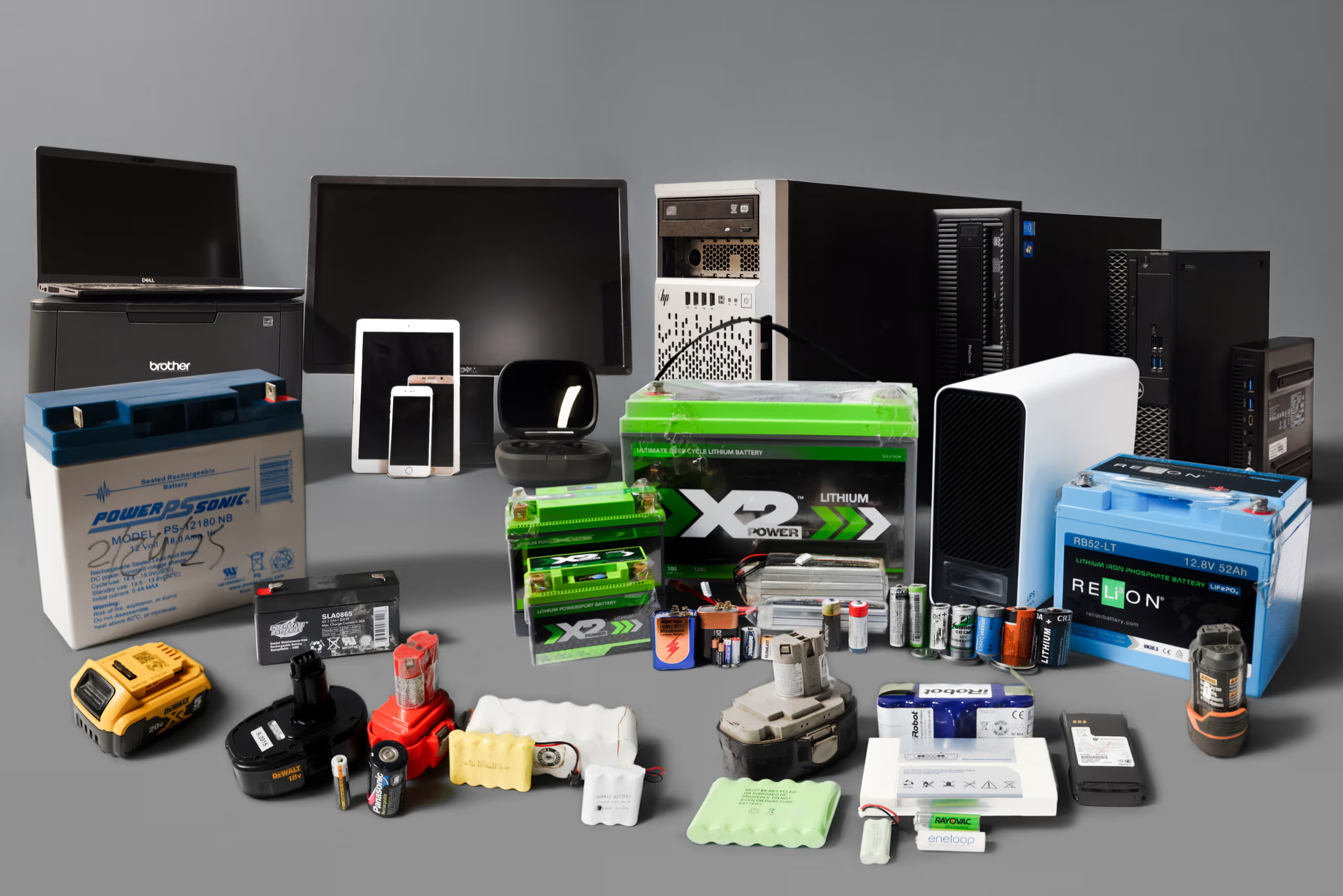

Simplify your compliance and disposal process with bundled recycling services that handle both electronic devices and batteries in one streamlined solution.

Our scheduled, route-based pickups cover all major regions of California—ensuring efficient, on-time service no matter where you operate.
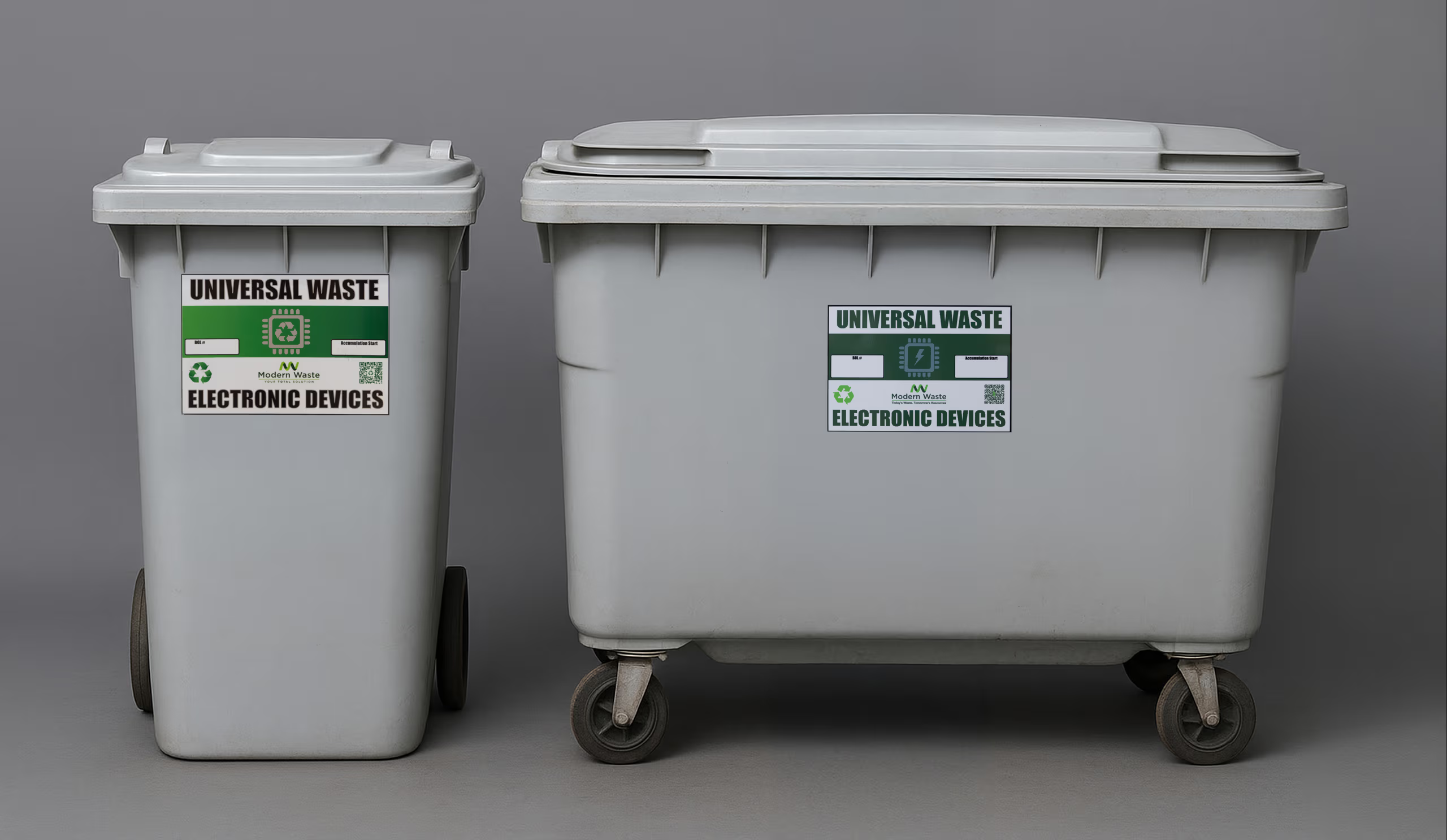
We provide clearly labeled, tamper-resistant containers to ensure safe and compliant collection of electronic waste and batteries at your location.

Modern Waste Solutions has served businesses and communities across California with dependable, environmentally responsible recycling solutions for over two decades.
We adhere to all California and federal regulations, ensuring your electronic and battery waste is managed with complete transparency and environmental responsibility.

Reviews
A little bit off the beaten track in Natomas, but Modern Waste quickly and efficiently helped me recycle my broken Lithium Iron Phosphate batteries at a reasonable $/lb fee (Sac county e-waste will not accept these items). Ramiro and Vincent were very friendly and helpful.

Chris was awesome! He came in and picked up all of the e-waste we had ready for him. He was polite and professional throughout the entire process. He handled the equipment with care, including the site equipment that was already in place. I am very happy with his service and appreciate the great job he did.

Aaron and Vincent were awesome, excellent customer service!

Great guys, excellent customer service, highly recommend!

Polite, quick and easy.

Chris from modern waste was the most outstanding respectful person I ever met my life when he was done he offered to sweep the floors. He offered so much even though he was limited on time he went out of his way and he’s over beyond best guy I ever met thank you so much for your service services Dan ITG.

Data center decommissioning is a controlled change project that retires workloads, infrastructure, and records without interrupting systems that must remain live. Here is the full process, from go/no-go to final reconciliation.
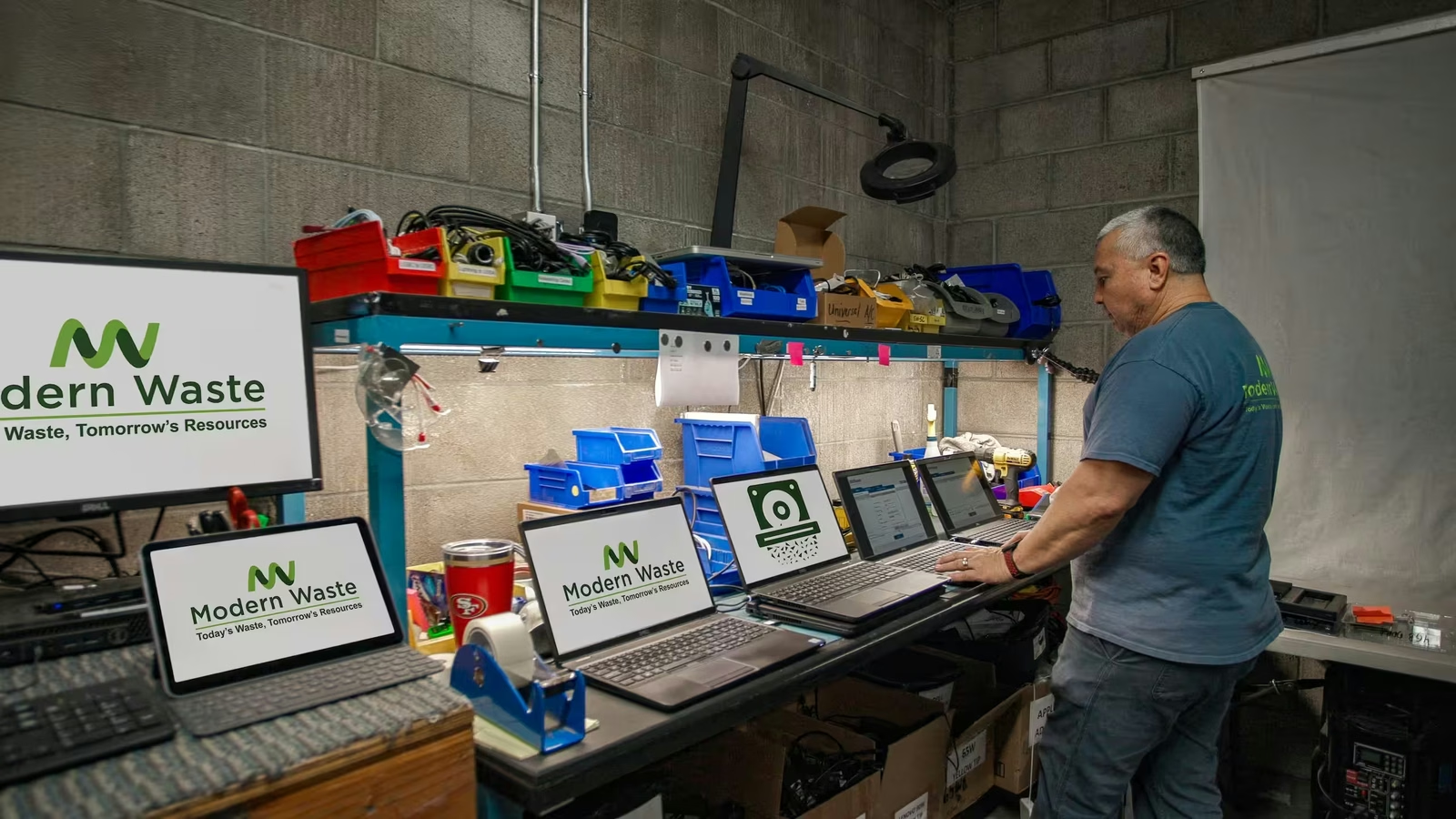
A mature ITAD program connects asset ownership, data security, environmental compliance, logistics, financial recovery, and reconciliation. Here is how the process works, what it costs, and how to evaluate a provider.
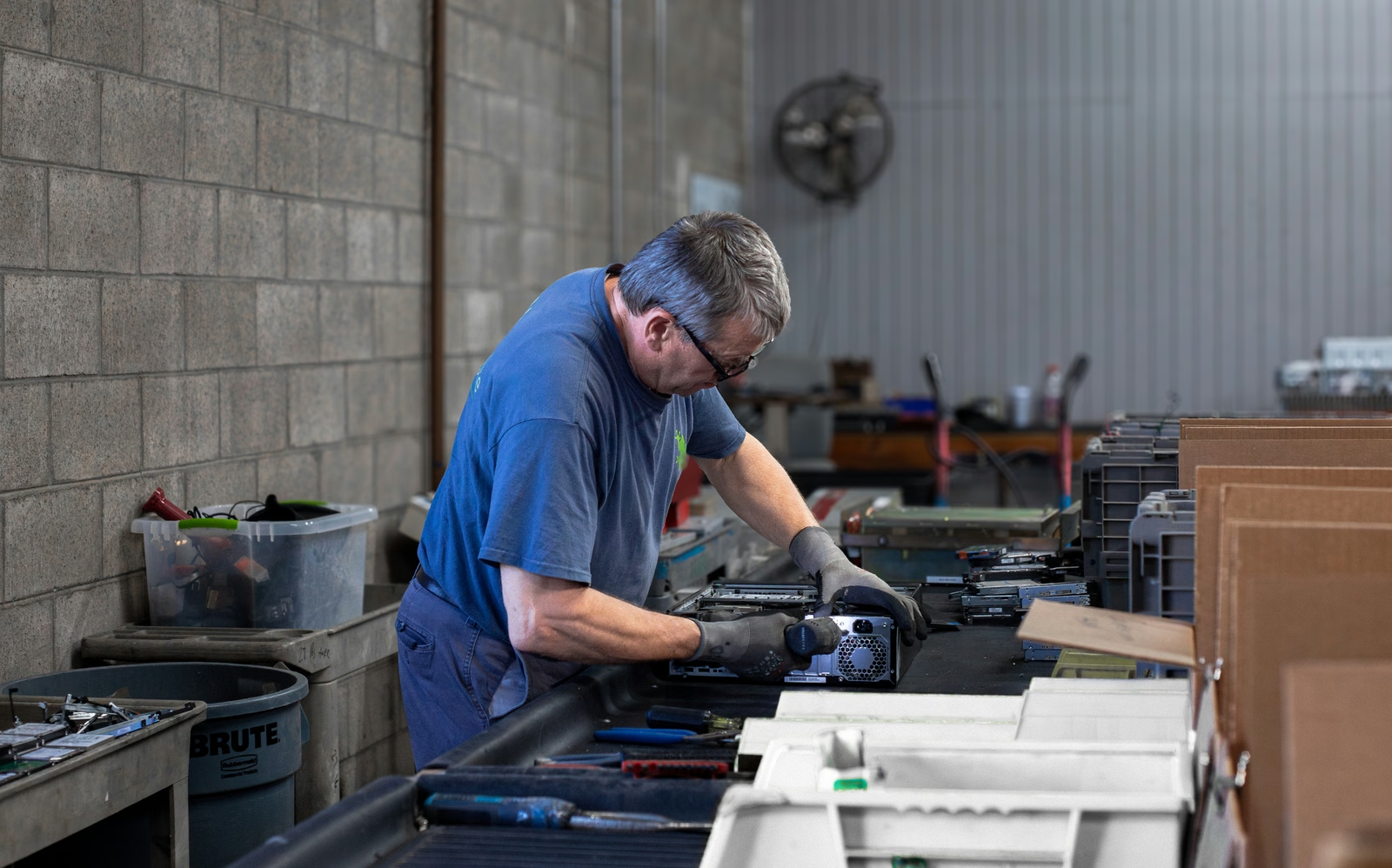
IT equipment liquidation converts marketable retired assets into documented financial recovery while routing nonmarketable equipment to responsible recycling. Here is how to decide which path fits each asset.