
Published October 2, 2026 · 10 min read · Updated October 2, 2026
IT Equipment Liquidation and Recycling for Retired Business Assets
IT equipment liquidation converts marketable retired assets into documented financial recovery while routing nonmarketable equipment to responsible recycling. Here is how to decide which path fits each asset.

IT equipment liquidation converts marketable retired assets into documented financial recovery while routing nonmarketable equipment to reuse, parts harvesting, or responsible recycling. It is not a blanket auction of everything in a server room. Data, ownership, software rights, condition, buyer qualification, logistics, and unsold inventory must be controlled before value is realized.
Modern Waste Solutions supports electronics recycling, secure data destruction, asset tracking, pickup, and reporting across California. A hybrid disposition plan can preserve resale value where it exists and provide an accountable recycling route for the remainder.
IT equipment liquidation is the structured sale or transfer of surplus business technology after ownership, data, and condition are verified. The process can use direct buyers, wholesale channels, brokers, consignment, auctions, employee sales, or other approved routes. The organization should choose channels based on equipment type, volume, market timing, warranty, sales risk, and reporting needs.
- Build the inventory. Capture manufacturer, model, configuration, serial number, age, condition, accessories, location, ownership, and data status.
- Test and grade. Verify function, cosmetic condition, components, firmware, and support status under a documented grading standard.
- Sanitize and validate. Apply the approved media method before buyer access and retain the result.
- Research the market. Use recent comparable sales, buyer demand, channel fees, freight, and expected sell-through rather than original purchase price.
- Select the channel. Match asset class and volume to direct sale, wholesale lot, consignment, donation, internal reuse, or recycling.
- Complete sale and transfer. Control title, payment, taxes, warranties, software, export, shipping, and buyer identity.
- Settle transparently. Report gross proceeds, deductions, returns, unsold assets, and net recovery.
| Financial term | Meaning |
|---|---|
| Gross offer or proceeds | Amount offered or received before fees and costs |
| Direct costs | Testing, labor, repair, parts, data treatment, packaging, freight |
| Channel fees | Auction, marketplace, broker, payment, warranty, or remarketing fees |
| Reserves and returns | Amount held for buyer claims, defects, or unsold risk |
| Net recovery | Gross proceeds minus all approved deductions |
Value is strongest when assets are current, complete, functional, clean, supported, and accompanied by rails, chargers, licenses that may be legally transferred, and accurate configuration data. Delayed disposition erodes value as equipment ages and market supply grows.
Liquidation does not eliminate recycling. Failed drives, broken displays, damaged batteries, obsolete accessories, and unsold systems still need approved routes. The program should define when an asset leaves the sales channel and enters recycling so inventory does not remain indefinitely with a broker.
Data-center liquidation involves concentrated value and greater technical and logistical complexity. Servers, storage arrays, network equipment, racks, power distribution, and UPS systems can be heavy, configured in multi-part assemblies, dependent on licenses, and difficult to test after shutdown. Office refreshes contain more standardized endpoints but may span many locations and users.
| Planning factor | Data-center equipment | Office-device refresh |
|---|---|---|
| Asset types | Servers, storage, switches, racks, UPS, PDUs, cabling | Laptops, desktops, monitors, docks, printers, phones |
| Dependency risk | Live workloads, clusters, backups, maintenance contracts | User migration, local files, accessories, remote devices |
| Deinstallation | Electrical isolation, rack work, rigging, drive mapping | Desk collection, account removal, palletization |
| Configuration value | CPU, memory, drives, cards, licenses, rails | Model, processor, memory, storage, charger, cosmetic grade |
| Data complexity | Multiple drives, arrays, tapes, management modules | Endpoint storage and mobile encryption |
| Buyer channels | Specialist server, network, and parts buyers | Wholesale endpoint, refurbished, donation, employee channels |
| Logistics | Heavy assets, docks, floor loading, crates, liftgates | Multi-site consolidation and standardized packing |
A data-center project begins with workload migration and change control. The equipment cannot be released merely because a replacement is installed. Owners must confirm backups, application acceptance, support termination, credentials, network isolation, and rollback closure. Drives should be mapped to chassis and arrays before removal so no media is lost.
Testing can be challenging. Once systems are powered down and removed, specialized fixtures, software, passwords, and compatible components may be required. The liquidation agreement should state whether equipment is sold tested, power-on tested, as-is, or for parts. It should also state who bears returns and misconfiguration risk.
UPS systems add batteries, weight, electrical work, and hazardous-material logistics. Racks and cabling may have low resale value relative to labor and freight. The project model should evaluate each class separately instead of applying one recovery percentage to the room.
Office refreshes benefit from standard collection kits, user signoff, remote-site schedules, and accessory control. Missing chargers and damaged screens can materially reduce value. Data-center liquidation benefits from an engineering inventory, maintenance history, configuration export, and specialist buyer strategy.
Disposition should maximize defensible net value while protecting data, safety, contracts, and environmental obligations. A decision matrix prevents market enthusiasm from overriding security or transferring unusable equipment to another organization.
| Criteria | Internal reuse | Liquidation | Donation | Recycling |
|---|---|---|---|---|
| Function | Fully functional and supported | Functional or economically repairable | Functional and useful to recipient | Failed, obsolete, unsafe, or uneconomic |
| Data | Sanitized for controlled reuse | Sanitized and validated before sale | Sanitized and validated before transfer | Sanitized or physically destroyed |
| Market demand | Internal need exists | Verified buyer demand and positive net value | Recipient need and acceptance confirmed | Little legitimate reuse demand |
| Support | Compatible with internal standards | Adequate for disclosed resale condition | Recipient can support equipment | Unsupported or restricted |
| Logistics | Transfer cost is reasonable | Freight and channel fees preserve net value | Delivery does not exceed benefit | Qualified recycling route available |
| Risk | Security and ownership controlled | Buyer, warranty, export, licensing controlled | Donation, privacy, tax, and liability approved | Hazardous components and downstream controls addressed |
Internal reuse is usually preferred when equipment remains supported and can meet a documented need. It avoids a new purchase but should not become a way to hide aging equipment or bypass security baselines. The receiving department should accept support, configuration, and inventory responsibility.
Liquidation fits equipment with positive expected net value. Estimate sell-through, not just listing price. Include testing, sanitization, repair, storage, fees, freight, returns, and unsold routing. A direct offer can be lower than a speculative auction estimate but provide faster, more predictable settlement.
Donation should meet a real recipient need. Confirm that devices are complete, functional, licensed appropriately, and supported long enough to be useful. Document data treatment, ownership transfer, and receipt. Do not shift broken devices or near-term disposal costs to a nonprofit.
Recycling is appropriate for unsafe, damaged, obsolete, low-value, regulated, or unsold equipment. Use a provider with suitable data and downstream controls. EPA's certified recycler page is a useful starting point for evaluating R2 and e-Stewards credentials.
Mixed lots normally require more than one path. The inventory should record the decision and final outcome for each serialized asset or approved lot.
Liquidation introduces additional parties and incentives: brokers, marketplaces, buyers, freight carriers, repair facilities, and return channels. Data treatment must occur before those parties gain access unless the contract establishes an equally controlled process approved by the organization.
- Freeze the release inventory and confirm legal holds, ownership, and authorization.
- Secure equipment in a controlled staging area and record every movement.
- Identify all media, including drives in servers, arrays, printers, and network appliances.
- Select a Clear, Purge, or Destroy outcome using current NIST SP 800-88 Rev. 2.
- Perform and verify the method; validate that the result is acceptable for sale or transfer.
- Physically destroy failed media or route it through another approved technique.
- Release only sanitized equipment to testing, repair, photography, listing, or buyers.
- Track sale, return, unsold inventory, and final recycling through closure.
| Custody event | Record |
|---|---|
| Removal from service | Asset owner, date, location, configuration |
| Move to staging | Releasing and receiving staff, container or pallet |
| Vendor pickup | Vehicle, driver, seal, scan/count, time |
| Facility receipt | Reconciliation and condition exceptions |
| Sanitization | Method, tool, result, verification, validation |
| Buyer shipment | Buyer, asset, title, carrier, tracking, date |
| Return or recycling | Reason, new custody event, final disposition |
Buyer restrictions should address onward sale, export, sanctioned parties, prohibited end uses, software, warranties, and return handling. Returned equipment must re-enter secured control; it should not sit in a general receiving area with unknown data status.
Chain-of-custody evidence should use stable asset identifiers. If labels are missing, create a controlled project ID and photograph or describe the asset for identification. Missing or duplicate serial numbers require an exception record, not manual deletion from the inventory.
Contractually require incident notification, subcontractor disclosure, record access, and a defined response if media is lost. Insurance should match the service and data exposure. A certificate of sanitization supports the technical event, while custody and sales records support physical control.
A hybrid strategy routes each asset to its best controlled outcome. It avoids two common mistakes: recycling valuable equipment without testing and trying to sell obsolete equipment long after storage and fees have consumed its value. The program evaluates marketability and environmental route together.
| Asset group | Primary route | Required evidence |
|---|---|---|
| Current functional servers | Sanitized resale or internal reuse | Configuration, test grade, sanitization, sale or transfer |
| Older functional endpoints | Wholesale, donation, or internal reuse | Grade, data result, buyer/recipient, settlement |
| Failed drives | Physical destruction and material recycling | Serial report and destruction certificate |
| Broken displays and peripherals | Certified electronics recycling | Count/weight and recycling certificate |
| Batteries and UPS modules | Chemistry-specific recycling | Battery inventory, custody, receiving record |
| Unsold inventory | Time-bound price reduction then recycling | Aging report, approval, final outcome |
Financial reporting should separate reuse savings, resale proceeds, cost avoidance, service fees, and net settlement. Do not present gross sales as program profit. ESG reporting should use defined measures such as assets reused, weight recycled, battery streams managed, and exceptions resolved. Avoid unsupported claims about emissions or landfill diversion unless the calculation method and boundaries are documented.
Transparent settlement improves governance. The provider should show gross sale amount, channel, testing and repair, fees, freight, returns, reserves, and net payment. Lot-level reporting may be appropriate for commodity equipment, but high-value serialized assets should remain traceable.
Downstream reporting matters for the nonmarketable portion. The liquidation vendor may not be the recycler. Ask which facility receives each material stream, how certifications are verified, and whether the organization can audit or review changes. Modern Waste Solutions' electronic recycling service can provide a California recycling path for equipment that does not qualify for secure reuse.
Set time limits. A device should not stay in “pending sale” indefinitely. Define marketing periods and price floors, then authorize donation, parts recovery, or recycling. This protects value while preventing forgotten inventory from becoming a security and storage problem.
Choose disposition at the asset-class level and document exceptions. Internal reuse fits supported equipment with a real need. Liquidation fits marketable assets with positive net recovery. Donation fits functional equipment matched to an accountable recipient. Recycling fits unsafe, obsolete, low-value, or unsold material. Physical destruction fits media that cannot be securely sanitized or must be destroyed by policy.
| Decision question | If yes | If no |
|---|---|---|
| Is the asset owned and free of holds? | Continue evaluation | Do not release |
| Is it safe, functional, and supported? | Consider reuse, sale, or donation | Consider parts or recycling |
| Can data be sanitized and validated? | Permit approved transfer route | Destroy media before disposition |
| Is expected net value positive? | Select a controlled sales channel | Recycle or donate if appropriate |
| Is a legitimate recipient or buyer available? | Document transfer and final outcome | Use a time-bound fallback route |
| Are hazardous components controlled? | Proceed with approved logistics | Isolate and obtain specialist review |
Practical recommendations are to start valuation before deinstallation, use one inventory across all routes, and require transparent settlement. Review a sample of buyer and downstream records. Keep unsold-asset aging visible and apply a deadline.
Assign each class a primary route, an alternate route, an approval owner, and a maximum holding period. For example, current servers may move from direct sale to wholesale after a defined period, while failed storage media should bypass resale and proceed to controlled destruction. Revisit decisions when testing reveals a different configuration, condition, or data risk. The disposition plan should permit controlled changes without allowing assets to disappear into an undefined “pending” status.
At closeout, reconcile the number and identity of assets released with units reused, sold, donated, dismantled, and recycled. Match proceeds and deductions to the same population. Retain sanitization evidence for data-bearing equipment, recipient or buyer records for transferred assets, recycling documentation for residual material, and an exception log showing final resolution. This combined operational, financial, and environmental record is what demonstrates that the selected path was carried through.
Modern Waste Solutions can support inventory review, data destruction, pickup, and recycling for retired California business assets. Organizations can use the electronic waste recycling service to plan the nonmarketable and exception portion of a liquidation project.
- NIST SP 800-88 Rev. 2, Guidelines for Media Sanitization: csrc.nist.gov/pubs/sp/800/88/r2/final
- EPA, Certified Electronics Recyclers: epa.gov/electronics-batteries-management/certified-electronics-recyclers
- Modern Waste Solutions: Electronic Waste Recycling
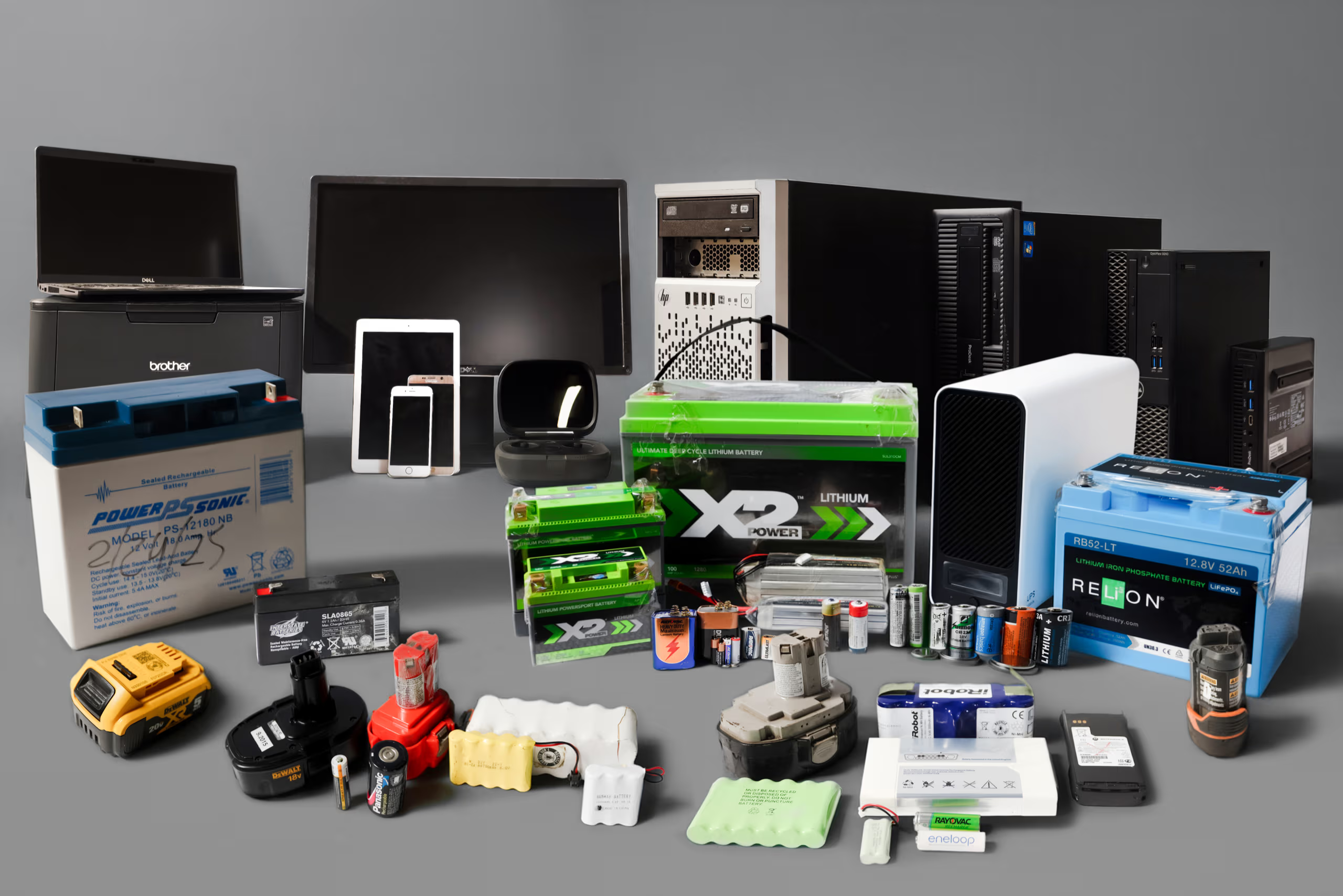

Simplify your compliance and disposal process with bundled recycling services that handle both electronic devices and batteries in one streamlined solution.

Our scheduled, route-based pickups cover all major regions of California—ensuring efficient, on-time service no matter where you operate.
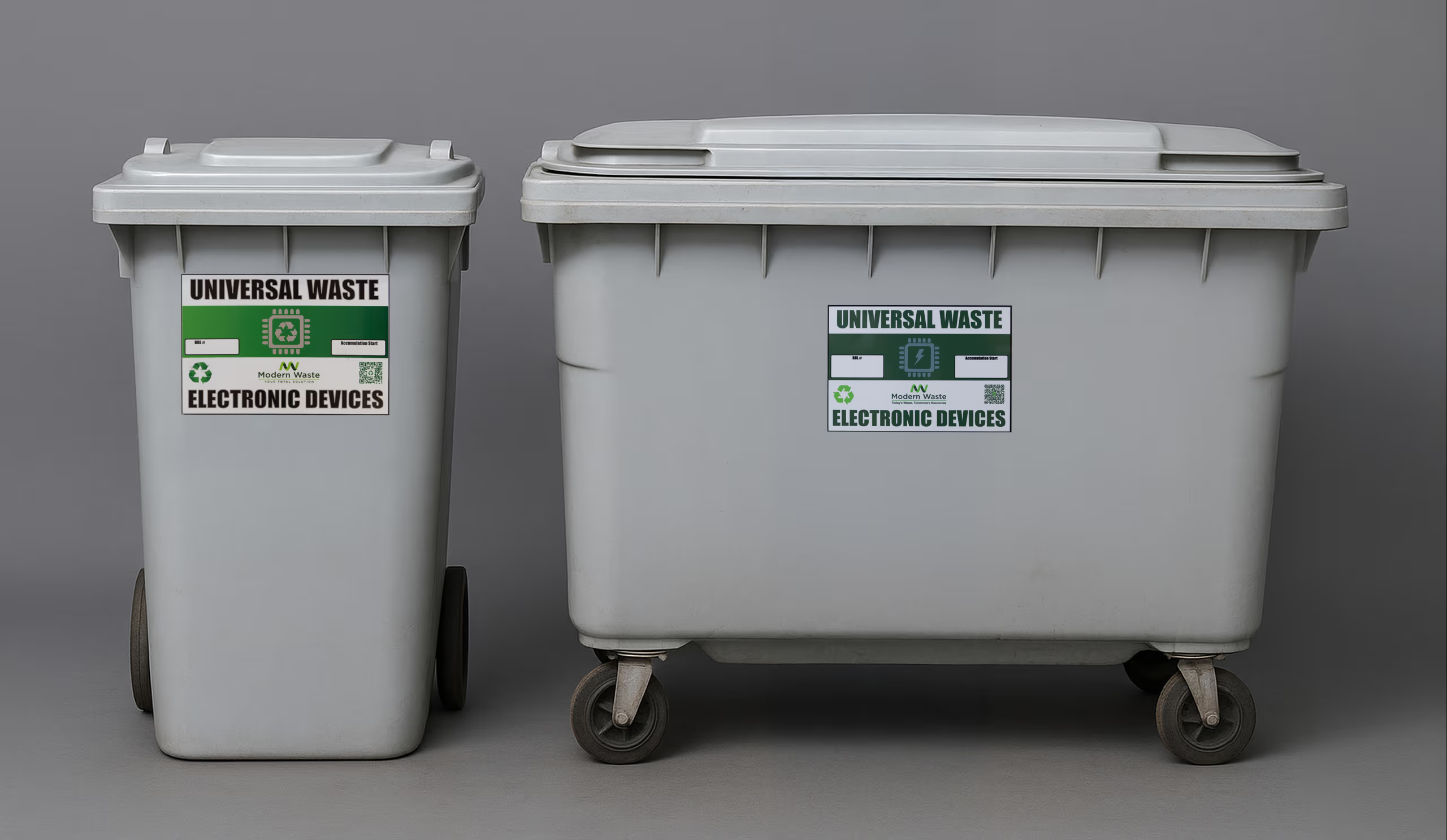
We provide clearly labeled, tamper-resistant containers to ensure safe and compliant collection of electronic waste and batteries at your location.

Modern Waste Solutions has served businesses and communities across California with dependable, environmentally responsible recycling solutions for over two decades.
We adhere to all California and federal regulations, ensuring your electronic and battery waste is managed with complete transparency and environmental responsibility.

Reviews
A little bit off the beaten track in Natomas, but Modern Waste quickly and efficiently helped me recycle my broken Lithium Iron Phosphate batteries at a reasonable $/lb fee (Sac county e-waste will not accept these items). Ramiro and Vincent were very friendly and helpful.

Chris was awesome! He came in and picked up all of the e-waste we had ready for him. He was polite and professional throughout the entire process. He handled the equipment with care, including the site equipment that was already in place. I am very happy with his service and appreciate the great job he did.

Aaron and Vincent were awesome, excellent customer service!

Great guys, excellent customer service, highly recommend!

Polite, quick and easy.

Chris from modern waste was the most outstanding respectful person I ever met my life when he was done he offered to sweep the floors. He offered so much even though he was limited on time he went out of his way and he’s over beyond best guy I ever met thank you so much for your service services Dan ITG.


Data center decommissioning is a controlled change project that retires workloads, infrastructure, and records without interrupting systems that must remain live. Here is the full process, from go/no-go to final reconciliation.
A mature ITAD program connects asset ownership, data security, environmental compliance, logistics, financial recovery, and reconciliation. Here is how the process works, what it costs, and how to evaluate a provider.
IT equipment liquidation converts marketable retired assets into documented financial recovery while routing nonmarketable equipment to responsible recycling. Here is how to decide which path fits each asset.