
Published October 2, 2026 · 10 min read · Updated October 2, 2026
IT Asset Disposition Best Practices for California Businesses
A mature ITAD program connects asset ownership, data security, environmental compliance, logistics, financial recovery, and reconciliation. Here is how the process works, what it costs, and how to evaluate a provider.
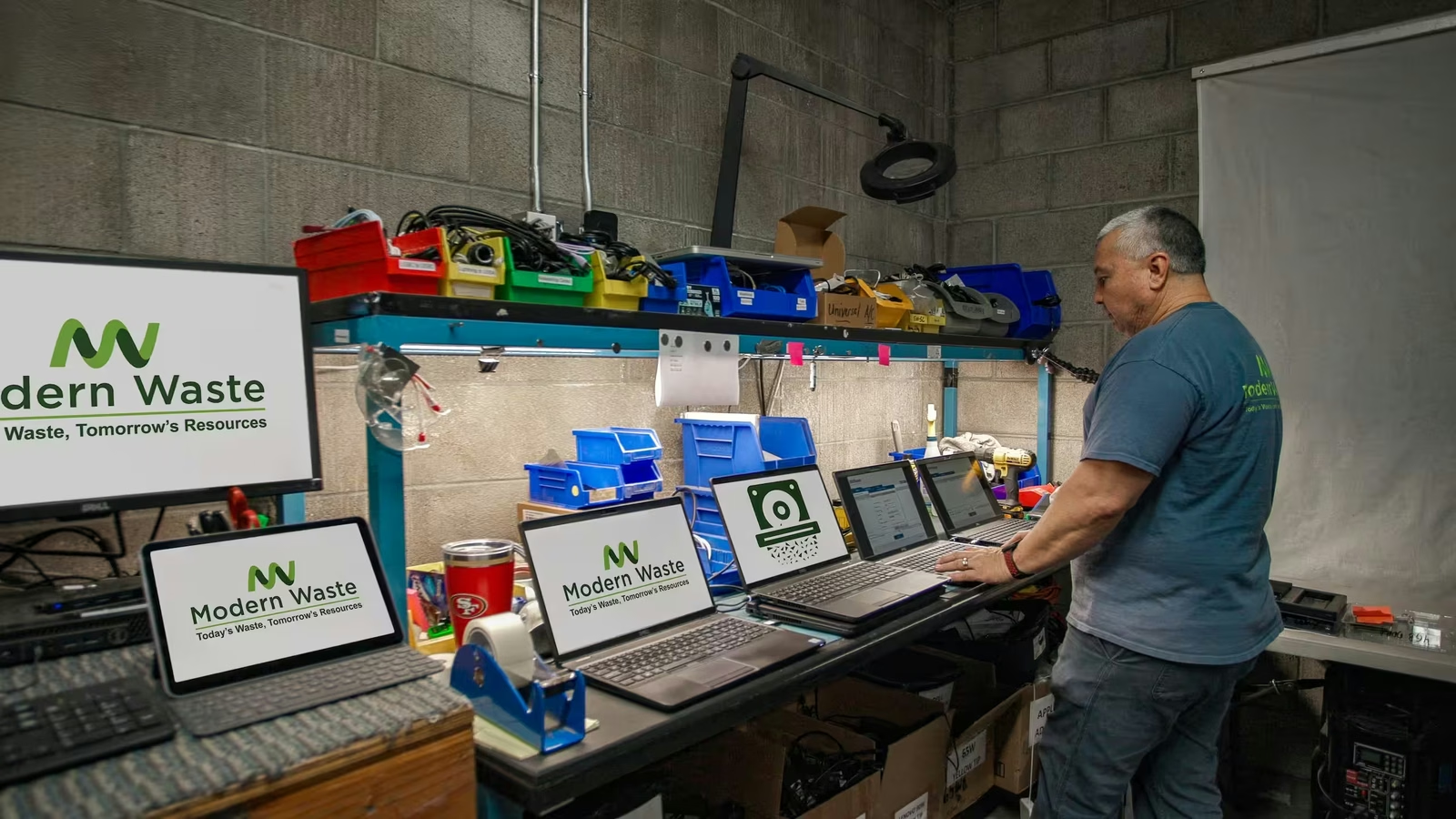
IT asset disposition, or ITAD, is the controlled retirement of technology from active inventory through reuse, resale, return, donation, data sanitization, destruction, and recycling. It is broader than hauling equipment away. A mature ITAD program connects asset ownership, information security, environmental compliance, logistics, financial recovery, vendor governance, and final reconciliation.
Modern Waste Solutions provides electronics recycling, secure data destruction, on-site hard drive shredding, pickup, tracking, and reports throughout California. The business still owns the decisions that precede service: what may leave, what data treatment is required, and what evidence must close each asset.
IT asset disposition is the final operational stage of IT asset management. It begins when equipment is identified for retirement and ends only after the asset has a validated outcome and has been removed from financial, technical, security, and physical inventories. The process should cover owned, leased, loaned, embedded, and third-party equipment under the organization's control.
| Asset class | Examples | Primary disposition concern |
|---|---|---|
| End-user endpoints | Desktops, laptops, thin clients, tablets, phones | Data, account locks, battery condition, reuse value |
| Data-center equipment | Servers, storage arrays, backup appliances, racks | Multiple drives, configuration, weight, deinstallation, resale |
| Storage media | HDDs, SSDs, tapes, removable flash, optical media | Clear, Purge, Destroy decision and asset-level evidence |
| Network and telecom | Routers, switches, firewalls, access points, PBX, radios | Credentials, certificates, configuration, controlled resale |
| Print and imaging | Printers, copiers, scanners, multifunction devices | Internal storage, address books, leased status, toner |
| Peripherals | Monitors, docks, keyboards, cables, power supplies | Count/weight control, batteries, lamps, reuse potential |
| Specialized devices | Medical, laboratory, industrial, security, POS | Data, contamination, calibration, radiation, manufacturer rules |
ITAD differs from basic recycling because it evaluates several outcomes. A functioning laptop may be sanitized and remarketed. A failed hard drive may be physically destroyed. A monitor may be tested for reuse. Batteries may enter a chemistry-specific stream. Remaining metals, plastics, glass, boards, and components may be recycled. Those paths must remain connected to one approved inventory.
NIST SP 1800-5 frames IT asset management as a cybersecurity capability: organizations need visibility into the devices and systems they possess. That visibility remains essential at retirement. An asset that disappears from the network but remains in a closet or vendor truck can still contain data and create risk.
California businesses also need device and waste classification. Some nonfunctioning electronics or components may be hazardous waste; batteries and lamps can require separate management. EPA's certified recycler guidance identifies R2 and e-Stewards as accredited certification standards for electronics recyclers, but certification review should match the processing site and service scope.
The ITAD inventory should therefore include every device with ownership, data, environmental, safety, financial, or contractual significance—not only capital assets above an accounting threshold.
A secure process starts with a project charter or recurring policy that defines scope, owners, asset detail, data outcome, vendor responsibilities, and acceptance criteria. Each phase should produce evidence that becomes an input to the next phase.
- Discover and approve: identify candidate assets, confirm ownership, and resolve legal holds, lease terms, investigations, and business dependencies.
- Inventory and classify: capture asset tag, serial number, device type, location, condition, storage media, battery, data class, and proposed outcome.
- Deinstall and stage: follow change control, remove equipment safely, protect reusable assets, isolate exceptions, and restrict access.
- Transfer custody: scan or count equipment, record releasing and receiving parties, use secure containers or vehicles, and document discrepancies.
- Sanitize or destroy: apply the approved NIST-aligned outcome and technique, verify completion, validate acceptability, and escalate failures.
- Test and route: grade reusable equipment, select legitimate sales or donation channels, and send nonreusable material to qualified recycling.
- Reconcile and settle: match received assets to the release inventory, resolve exceptions, and calculate gross recovery, fees, and net settlement.
- Close and retain: issue certificates and reports, remove assets from systems, document final disposition, and retain evidence.
| Phase | Control | Evidence |
|---|---|---|
| Planning | Approved scope and responsibility matrix | Project plan or service procedure |
| Inventory | Stable asset identifier and data decision | Release register |
| Logistics | Authorized handoff and controlled transport | Custody log and seal/container record |
| Sanitization | Media-appropriate method | Tool or destruction record |
| Reuse/recycling | Approved disposition criteria | Grading and downstream outcome |
| Closeout | Three-way reconciliation | Final asset report, certificates, exceptions |
The three-way reconciliation compares assets authorized for release, assets received by the provider, and assets assigned a final outcome. Missing, duplicate, extra, or unreadable records stay open until investigated. A certificate should not close an unresolved difference.
NIST SP 800-88 Rev. 2 supports the media-sanitization stage, while NIST SP 1800-5 supports lifecycle visibility. Together they reinforce a basic principle: the organization must know which asset it has and what security outcome was achieved.
A secure ITAD provider uses layered controls. No badge or certificate replaces custody, inventory, staff, facility, method, exception, and downstream review. Procurement should evaluate actual operations and confirm that the facility performing the service is within the relevant certificate scope.
| Control area | Evidence to request | Risk addressed |
|---|---|---|
| Chain of custody | Pickup procedure, scan events, seals, vehicle and facility controls | Loss, substitution, unauthorized access |
| Personnel | Screening, role authorization, training, termination controls | Insider misuse and procedural error |
| Data sanitization | Method matrix, tools, verification, validation, failure process | Recoverable data and unsupported method |
| Physical destruction | Equipment capability, maintenance, media acceptance, result criteria | Incomplete destruction |
| Facility security | Access logs, cameras, alarms, visitor controls, secured staging | Theft and unobserved handling |
| Certification | Current certificate, site, scope, exclusions, directory verification | Misrepresented or irrelevant credential |
| Downstream due diligence | Approved processor list, audits, contracts, material flow | Uncontrolled export, disposal, or subcontracting |
| Insurance and incidents | Coverage, breach response, notification, corrective action | Financial and operational recovery |
R2 and e-Stewards certifications are commonly used in electronics recycling and ITAD. EPA recognizes both as accredited certification standards. They address areas such as environmental protection, worker health and safety, data security, reuse, and downstream management, but their structures and requirements differ. A buyer should not treat the logos as interchangeable or assume every corporate location is included.
Secure transport should match risk. Options may include locked containers, tamper seals, dedicated vehicles, screened drivers, GPS, continuous custody, and serialized scanning. The provider should explain when material is consolidated, where it is received, and whether intact data-bearing devices go to another site.
Sanitization must fit media technology. SSDs, HDDs, tapes, mobile devices, and embedded storage cannot all be handled by one generic overwrite. Failed logical sanitization should route to controlled physical destruction. Modern Waste Solutions' on-site hard drive shredding can support organizations that require witnessed destruction before fragments leave the site.
Downstream review should follow material, not stop at the first vendor. Ask how reusable equipment is sold, how batteries and lamps are handled, where board and metal fractions go, and how exceptions are recorded. Contract terms should provide audit rights, incident notification, subcontractor controls, and record access.
ITAD economics combine service cost and asset recovery. The correct measure is net settlement: gross sale or commodity proceeds minus testing, labor, data treatment, repairs, parts, marketplace fees, freight, packaging, storage, recycling charges, and other agreed deductions. A headline resale estimate can be misleading when it ignores those costs or the percentage of equipment that remains unsold.
| Cost or value factor | Effect on project economics |
|---|---|
| Volume and site count | Larger consolidated projects may improve route efficiency; many small sites add mobilization |
| Location and access | Stairs, escorts, remote sites, limited docks, and after-hours work add labor |
| Deinstallation | Rack removal, cabling, drive removal, and heavy lifting require time and skill |
| Data method | Serialized wiping, on-site shredding, witnessing, and custom reports add service effort |
| Device age and condition | Current, complete, functional assets generally have greater resale potential |
| Configuration and accessories | Memory, storage, chargers, rails, and licenses can affect marketability |
| Commodity mix | Boards, copper, steel, batteries, and glass have different processing economics |
| Freight and packing | Distance, pallets, crates, liftgates, and special packaging affect cost |
| Reporting | Serial-level portals and custom fields require more processing than weight-only receipts |
Value recovery should be governed by a written grading and sales policy. Define testing, data treatment, cosmetic grades, warranty, buyer channels, sales period, and unsold-asset route. Set approval thresholds for employee sales, donations, and export. Ensure software licenses and cloud accounts are not transferred improperly.
For bids, request a transparent fee schedule and settlement example. Confirm whether the provider uses a purchase model, consignment, revenue share, or guaranteed value. State when title transfers and who bears price decline, returns, fraud, and unsold inventory risk.
Recycling cost can rise when loads contain broken CRTs, damaged batteries, low-value plastics, mixed accessories, or specialized equipment. Accurate pre-project data lets the provider quote the real mix. Photographing pallets may help demonstrate condition, but it does not replace counts, models, and battery or data information.
Modern Waste Solutions evaluates equipment for data, reuse, dismantling, and recycling. Businesses should ask for a project-specific scope based on inventory, site access, data requirements, and reporting rather than assume all electronics have positive value.
Best practices make disposition predictable before equipment becomes surplus. Refresh plans should identify end-of-support dates, lease returns, data owners, reuse candidates, and budget. Waiting until a lease deadline or facility closure compresses decisions and increases the chance of missing drives, unsafe batteries, and poor resale timing.
- Maintain inventory accuracy. Reconcile physical, network, financial, and management-system records throughout the asset life.
- Classify data early. Tie device and media treatment to data sensitivity and intended disposition.
- Integrate legal holds. Prevent automatic retirement of assets subject to litigation, investigation, audit, or preservation.
- Separate reusable equipment. Protect it from cosmetic damage, missing parts, and mixed scrap handling.
- Approve vendors by site and scope. Verify certificates, insurance, downstream controls, incident duties, and reporting.
- Define reconciliation tolerance. High-risk serialized assets may require zero unresolved differences; low-risk lots may use controlled count or weight rules.
- Control exceptions. Establish secure storage, ownership, deadlines, and final evidence for failed wipes, missing serials, and damaged units.
- Audit records. Sample completed projects and compare inventory, custody, method, certificates, downstream outcome, and settlement.
Mobile ITAD services can reduce movement and internal handling during major refreshes. Technicians may inventory, remove drives, pack equipment, or shred media on-site. The benefit is strongest when the scope is clear and the mobile workflow connects to the same asset and reporting systems as facility processing.
| Risk | Preventive control | Detection control |
|---|---|---|
| Missing asset | Freeze inventory and restrict staging | Three-way reconciliation |
| Recoverable data | Approved media-specific method | Verification, validation, and sample audit |
| Damaged battery | Pre-pickup inspection and isolation | Exception log and qualified review |
| Unauthorized reuse | Written disposition authorization | Buyer and settlement review |
| Downstream failure | Certified provider and processor due diligence | Material-flow report and audit rights |
| Incomplete records | Required certificate schema | Closeout checklist and retention audit |
The most effective control is clear accountability. Assign one program owner who can coordinate IT, information security, EHS, procurement, finance, legal, records, and facilities. Without that role, each team may complete its own task while the overall chain remains incomplete.
Evaluate a proposal using weighted criteria tied to risk and service, not price alone. Require providers to respond to the same scope, inventory assumptions, method definitions, exception scenarios, and report fields. Conduct follow-up for any vague “fully compliant” claim.
| Criterion | Suggested weight | Evidence to evaluate |
|---|---|---|
| Data security and sanitization | 25% | Method matrix, tools, validation, failures, on-site option |
| Chain of custody and facility security | 20% | Logistics, scans, seals, access, incident controls |
| Environmental and downstream management | 15% | R2/e-Stewards or equivalent evidence, processors, material flow |
| Reporting and reconciliation | 15% | Sample certificates, serial report, exceptions, portal retention |
| Operations and California coverage | 10% | Capacity, routes, site labor, scheduling, specialized equipment |
| Financial transparency | 10% | Fees, recovery model, deductions, settlement timing |
| References, insurance, and contract terms | 5% | Coverage, audit rights, notification, subcontractors |
Weights should reflect the organization. A hospital may place more weight on data and custody; a multi-site retailer may emphasize route capacity and reporting; a data-center project may emphasize deinstallation and value recovery. Establish pass/fail criteria for legal authorization, insurance, and unacceptable downstream practices before scoring.
Practical recommendations are to run a pilot with a representative site, compare released and final inventories, inspect certificates, and test the provider's exception handling. Verify credentials in current directories and confirm that the named processing facility is covered.
The final selection record should preserve the request for proposal, bidder responses, scoring notes, credential checks, sample reports, contract exceptions, and approval. This creates a defensible explanation of why the provider was chosen and which controls were considered essential. After the first project, compare promised service levels with actual pickup timing, reconciliation accuracy, report quality, exception closure, and net settlement. Use that review to correct the scope before expanding the program to additional California locations.
Modern Waste Solutions can review inventory, site access, data methods, on-site shredding, electronics recycling, and California pickup logistics. Use its electronic waste recycling and on-site hard drive shredding pages to prepare a scoped proposal request.
- NIST SP 1800-5, IT Asset Management: csrc.nist.gov/pubs/sp/1800/5/final
- NIST SP 800-88 Rev. 2, Guidelines for Media Sanitization: csrc.nist.gov/pubs/sp/800/88/r2/final
- EPA, Certified Electronics Recyclers: epa.gov/electronics-batteries-management/certified-electronics-recyclers
- Modern Waste Solutions: Electronic Waste Recycling
- Modern Waste Solutions: On-Site Hard Drive Shredding
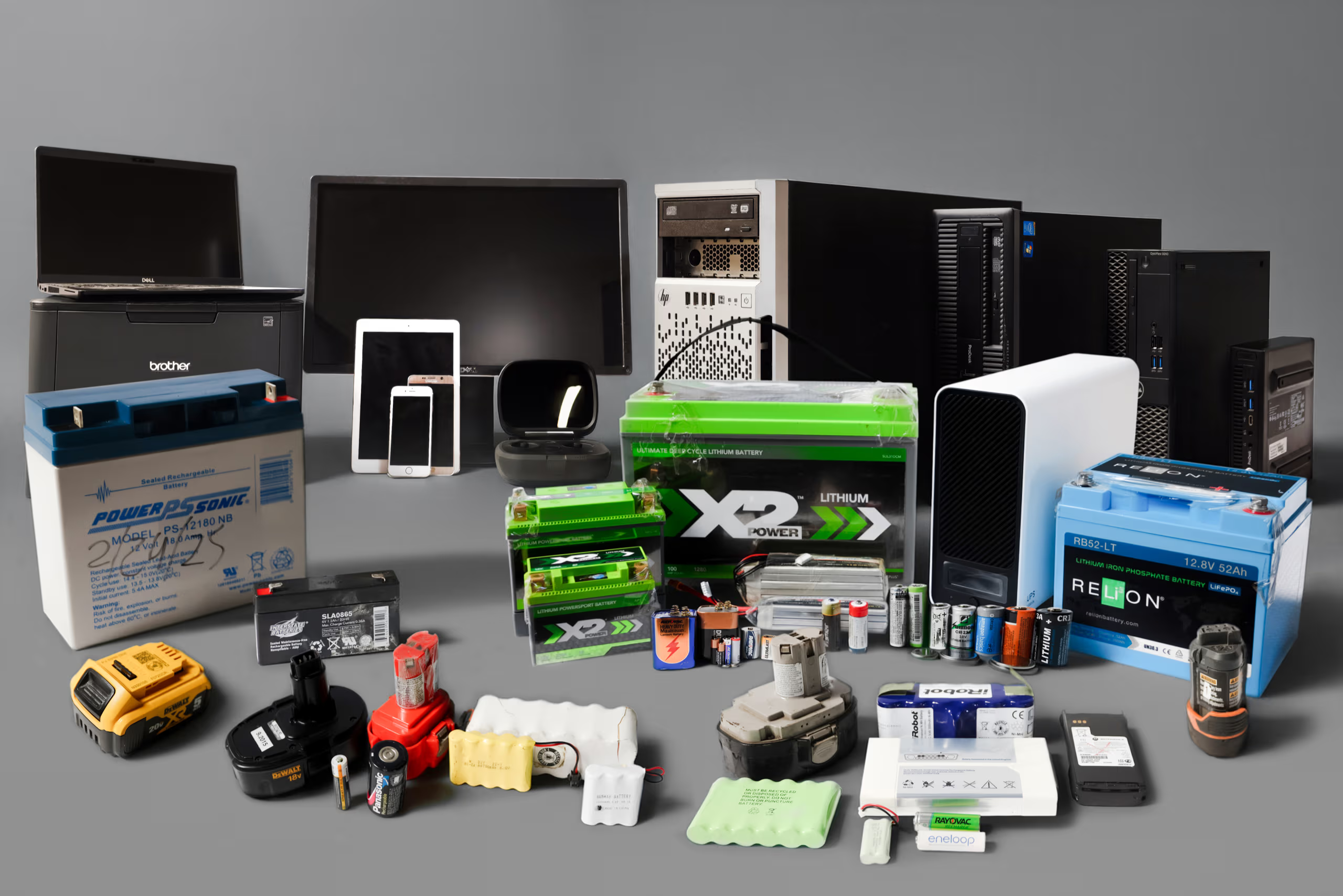

Simplify your compliance and disposal process with bundled recycling services that handle both electronic devices and batteries in one streamlined solution.

Our scheduled, route-based pickups cover all major regions of California—ensuring efficient, on-time service no matter where you operate.
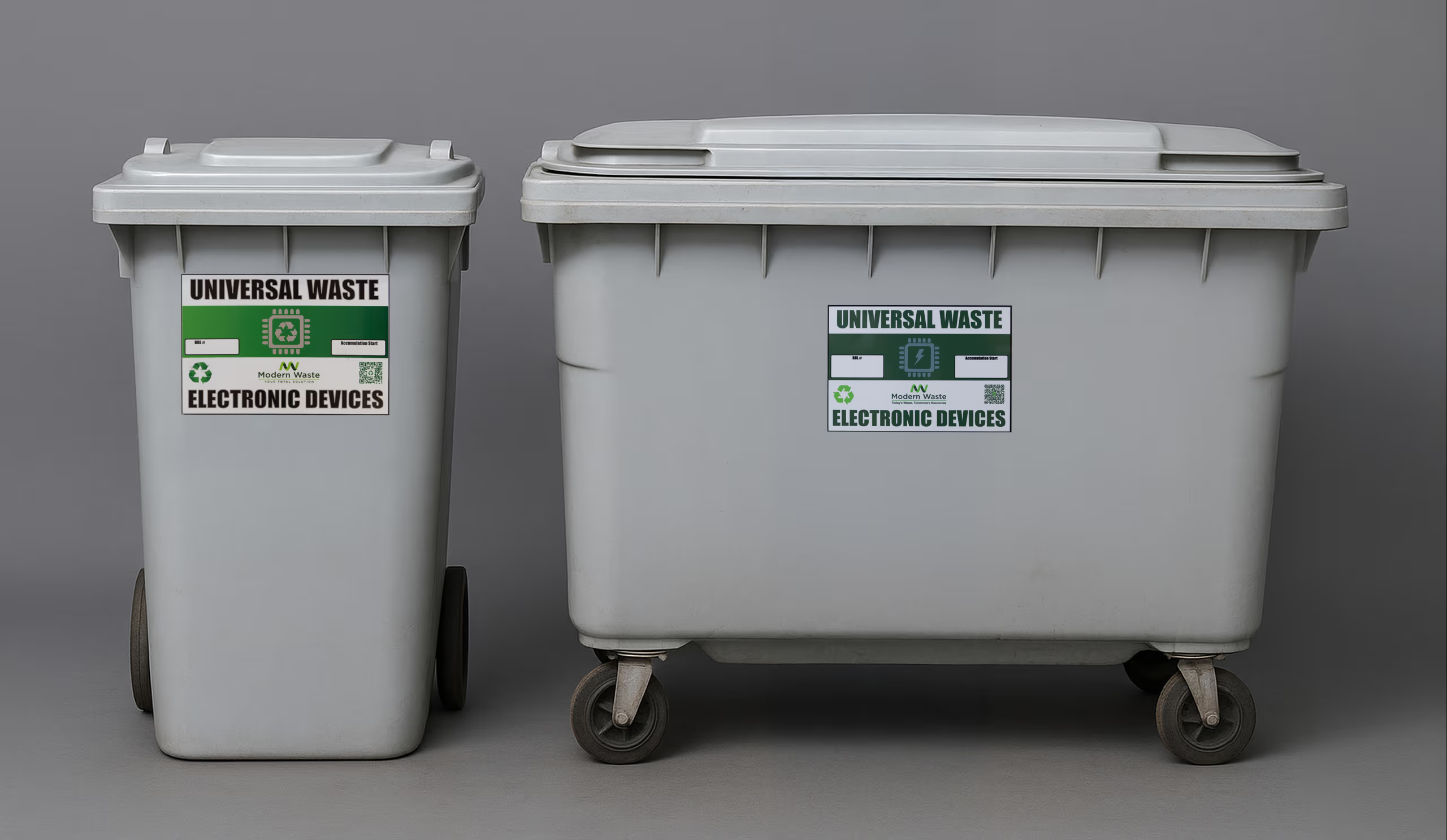
We provide clearly labeled, tamper-resistant containers to ensure safe and compliant collection of electronic waste and batteries at your location.

Modern Waste Solutions has served businesses and communities across California with dependable, environmentally responsible recycling solutions for over two decades.
We adhere to all California and federal regulations, ensuring your electronic and battery waste is managed with complete transparency and environmental responsibility.

Reviews
A little bit off the beaten track in Natomas, but Modern Waste quickly and efficiently helped me recycle my broken Lithium Iron Phosphate batteries at a reasonable $/lb fee (Sac county e-waste will not accept these items). Ramiro and Vincent were very friendly and helpful.

Chris was awesome! He came in and picked up all of the e-waste we had ready for him. He was polite and professional throughout the entire process. He handled the equipment with care, including the site equipment that was already in place. I am very happy with his service and appreciate the great job he did.

Aaron and Vincent were awesome, excellent customer service!

Great guys, excellent customer service, highly recommend!

Polite, quick and easy.

Chris from modern waste was the most outstanding respectful person I ever met my life when he was done he offered to sweep the floors. He offered so much even though he was limited on time he went out of his way and he’s over beyond best guy I ever met thank you so much for your service services Dan ITG.


Data center decommissioning is a controlled change project that retires workloads, infrastructure, and records without interrupting systems that must remain live. Here is the full process, from go/no-go to final reconciliation.
A mature ITAD program connects asset ownership, data security, environmental compliance, logistics, financial recovery, and reconciliation. Here is how the process works, what it costs, and how to evaluate a provider.

IT equipment liquidation converts marketable retired assets into documented financial recovery while routing nonmarketable equipment to responsible recycling. Here is how to decide which path fits each asset.