

Published August 27, 2026 · 13 min read · Updated September 27, 2026
Battery Recycling Process and Storage Safety for California Businesses
A practical guide to the battery recycling process for California businesses: collection, sorting, storage safety and disposal compliance under DTSC's Universal Waste Rule and OSHA guidance, and how to set up a safe pickup program.
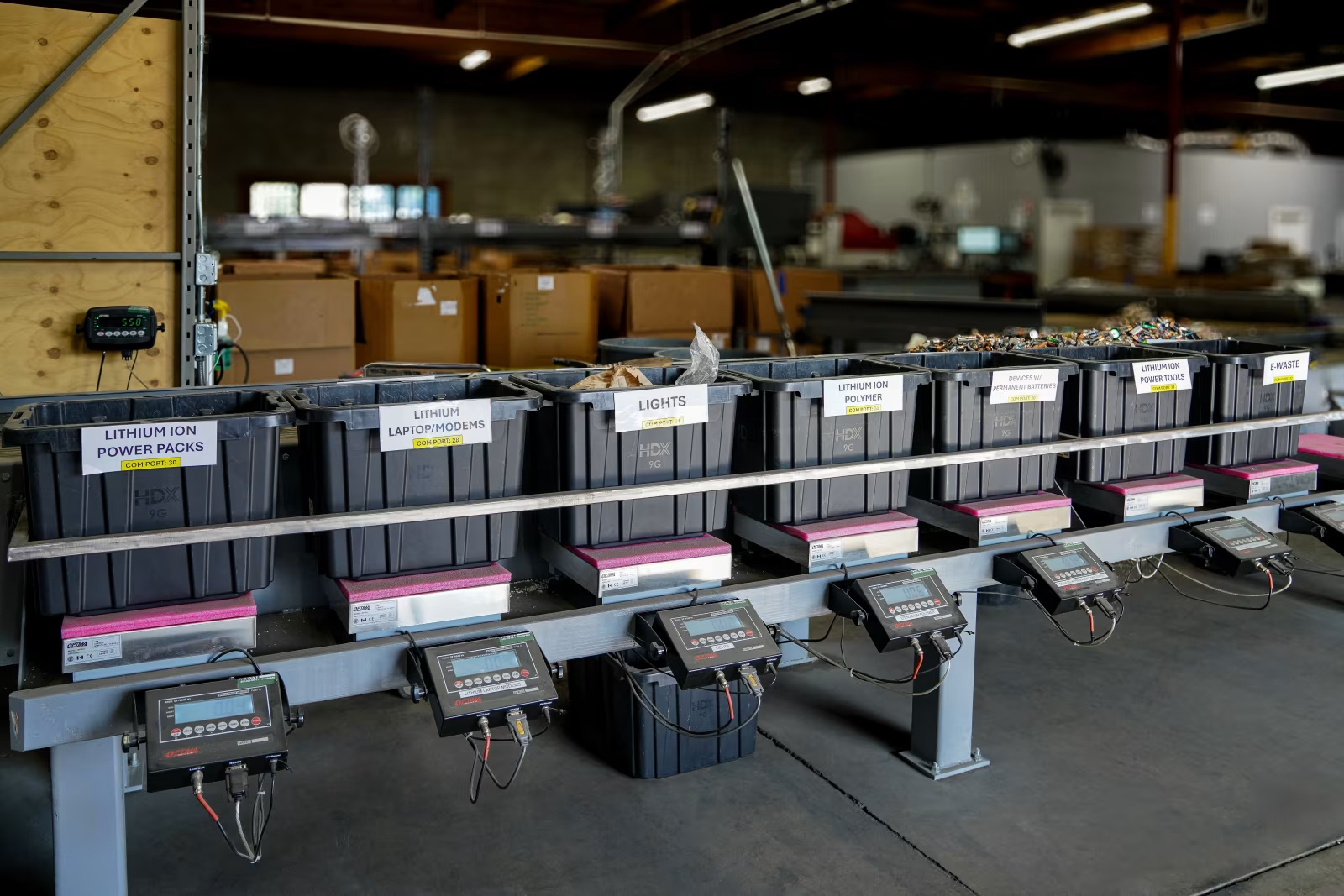
California businesses use batteries in laptops, tools, emergency lighting, vehicles, telecom systems, medical devices, and uninterruptible power supplies. Once those batteries are spent, damaged, or recalled, they become both a compliance issue and a workplace safety concern. A reliable program must identify chemistry, prevent short circuits, keep damaged units out of routine collection, and preserve records from pickup through recycling.
Modern Waste Solutions has operated in the recycling and data-destruction industry since 1999 from its Sacramento facility and serves organizations throughout California. Its battery program includes sorting, insulating, packaging, containers, labeling, transportation, and reporting. The following framework helps a business prepare material safely while recognizing that final requirements depend on battery type, condition, quantity, transportation method, and local authority rules.
The battery recycling process begins before a recycler receives the material. A business first identifies where batteries arise, which chemistries are present, and whether any unit is swollen, leaking, crushed, recalled, overheated, or otherwise damaged. This initial classification determines storage, packaging, carrier, and processing options. A mixed container with unidentified batteries is not the same waste stream as a documented pallet of intact sealed lead-acid batteries or a removed electric-vehicle pack.
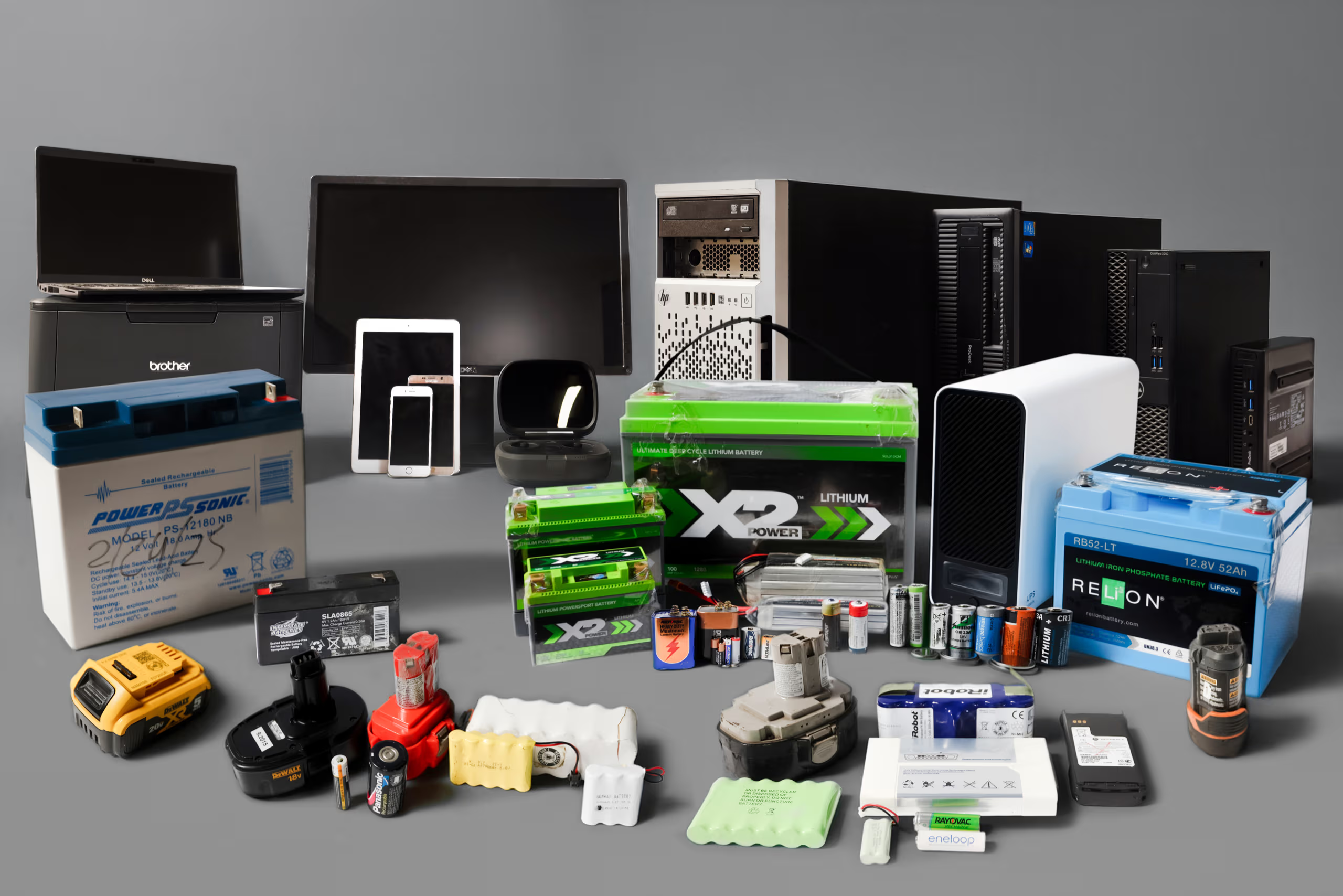
- Identify the source and chemistry. Record the device, battery label, chemistry, count or weight, and condition. Common categories include alkaline, lithium metal, lithium-ion, nickel-cadmium, nickel-metal hydride, and lead-acid.
- Protect against short circuits. Use a method appropriate to the battery and shipment, such as nonconductive terminal tape, individual bags, or approved internal packaging. Do not cover vents or damaged areas without specialist direction.
- Segregate incompatible or higher-risk material. Separate chemistries and remove damaged, defective, or recalled lithium batteries from the routine collection stream. Keep loose batteries away from metal objects and conductive debris.
- Transfer through an approved route. The shipping description, package, markings, labels, documentation, and carrier qualifications must match the material being transported.
The California DTSC battery guidance explains that discarded batteries can be hazardous waste and generally should not enter ordinary trash. Transportation adds a separate layer: PHMSA states that lithium batteries are regulated hazardous materials in commerce and that used batteries offered for disposal or recycling still require short-circuit protection and a fire-hazard assessment.
At the receiving facility, the recycler verifies the load, weighs or counts material, records exceptions, and sorts it into chemistry-specific processing channels. Lead-acid batteries may be broken down so lead components can be refined, plastic can be cleaned and pelletized, and electrolyte can be neutralized or converted for industrial use. Lithium-ion batteries may be discharged or otherwise made safe under controlled procedures, mechanically processed, and separated into metal-rich fractions for downstream recovery. Other chemistries follow different thermal, mechanical, or hydrometallurgical routes.
| Battery stream | Typical preparation focus | Typical recoverable fractions |
|---|---|---|
| Lead-acid | Upright handling, leak inspection, protected terminals | Lead, polypropylene, electrolyte-derived material |
| Lithium-ion | Short-circuit prevention, damage screening, fire controls | Copper, aluminum, steel, lithium- and transition-metal-bearing material |
| Nickel-cadmium | Chemistry segregation and controlled handling | Nickel, cadmium, steel |
| Nickel-metal hydride | Separation from lithium and alkaline streams | Nickel-bearing alloy and steel |
| Alkaline | Dry storage and chemistry identification | Steel, zinc- and manganese-bearing material |
Material recovery is only part of the outcome. The business should receive a transaction record that reconciles the shipped count or weight, identifies exceptions, and states the disposition route. Certificates and downstream reports should be matched to the original pickup record rather than filed as unconnected documents. This creates evidence that collection, transportation, processing, and recovery were part of one controlled chain.
California’s universal waste framework provides an alternative management system for certain hazardous wastes, including many discarded batteries, but it is not permission to place them in municipal trash or an ordinary recycling bin. A business must first determine what it has. Chemistry, condition, source, and intended destination can change the applicable route, and lead-acid batteries or damaged lithium batteries may require different handling from intact small batteries.
A handler should keep batteries in a manner that prevents releases and short circuits. Containers must be compatible with their contents, structurally sound, closed when appropriate, and managed so batteries are not crushed or exposed to conductive material. Employees who handle the waste need instructions appropriate to their responsibilities, including recognizing damage and using the escalation process. The accumulation area should be inspected regularly, and the business should be able to show when accumulation began.
Universal waste must be labeled or marked using the terminology permitted by the applicable rule. The label should identify the waste stream clearly, and the accumulation-start date should be documented through container dating, an inventory system, or another defensible method. Federal and California rules impose time and shipment requirements; businesses should verify current thresholds, notification duties, tracking obligations, and record-retention rules for their handler category instead of relying on a generic office checklist.
| Battery type or condition | Routine business handling approach | Important qualification |
|---|---|---|
| Intact alkaline or rechargeable small batteries | Segregate as appropriate, protect terminals when needed, label, and send to an authorized destination | Confirm chemistry and California handler requirements |
| Intact lithium-ion batteries | Protect terminals, separate from other chemistries, limit quantity, inspect, and use a qualified recycler/carrier | DOT transport rules apply when offered in commerce |
| Damaged, defective, or recalled lithium batteries | Isolate from routine collection and obtain specialist packaging and transport instructions | Do not ship as an ordinary intact-battery load |
| Spent lead-acid batteries | Store upright, protect from damage and leaks, and use the applicable lead-acid management route | Alternative standards may apply; verify destination acceptance |
| EV or large-format battery packs | Restrict access and obtain qualified technical and logistics review | High voltage, weight, damage, and shipping status require project-specific controls |
The destination matters as much as on-site handling. Material should go to a facility or intermediary authorized to receive it under the applicable rules. Before pickup, verify acceptance criteria, carrier responsibilities, packaging instructions, and whether the destination will issue weight, recycling, or destruction records.
Lead-acid, lithium, and mixed household-style batteries should not be treated as interchangeable. If a unit is hot, leaking, swollen, punctured, emitting odor or gas, or involved in an incident, employees should stop routine handling, restrict the area, and contact the organization’s safety lead and qualified service provider. The emergency response plan, safety data, manufacturer instructions, and local fire authority direction take priority over the normal collection procedure.
There is no single OSHA rule titled “lithium battery warehouse storage requirements” that replaces all other obligations. Employers must evaluate workplace hazards and comply with applicable standards, including hazard communication, emergency action, electrical safety, personal protective equipment, material handling, and any substance-specific requirements that apply to the operation. California employers must also consider Cal/OSHA requirements, California fire rules, adopted building and fire codes, permits, insurer conditions, and directions from the local authority having jurisdiction.
OSHA’s published lithium-ion guidance is valuable but should be described accurately. In its September 2025 QuickTakes guidance, OSHA identified thermal runaway, mechanical damage, internal short circuits, temperature extremes, and improper charging as concerns. It recommended dry, cool storage; manufacturer instructions; quantity limits; ventilation; gas monitoring in large storage locations; recycling at designated facilities; and separation of battery types. These measures support hazard control, but a facility still needs a site-specific code and risk review.
| Control area | Practical facility measure | Verification question |
|---|---|---|
| Temperature and moisture | Use a dry, cool location within manufacturer limits | Are temperature excursions recorded and investigated? |
| Short-circuit prevention | Protect exposed terminals and keep batteries away from metal debris | Can loose batteries contact each other or conductive shelving? |
| Chemistry separation | Separate lithium-ion, lithium metal, lead-acid, alkaline, and unknown units | Are bins unmistakably labeled and physically separated? |
| Quantity management | Limit accumulation and schedule pickups before containers overflow | Is there a documented maximum for each storage area? |
| Ventilation and detection | Evaluate ventilation and gas detection for larger or enclosed storage | Has a qualified safety or fire professional reviewed the space? |
| Inspection | Check heat, swelling, leakage, damage, corrosion, odor, and container condition | Is there a dated inspection log and escalation owner? |
| Training | Teach identification, prohibited actions, isolation, and emergency notification | Can employees explain what to do with a damaged unit? |
| Fire and emergency planning | Maintain clear access, emergency contacts, and coordinated response procedures | Has the local fire authority reviewed higher-hazard storage? |
Charging and end-of-life storage should be evaluated separately. A charging area introduces energized equipment, heat generation, charger compatibility, and the risk of unattended charging. A recycling accumulation area contains devices of uncertain age and condition. Combining both without defined controls can make early detection and inventory management harder.
Employees should never improvise with a smoking, hissing, hot, swollen, or leaking battery. The plan should define stop-work criteria, evacuation or isolation actions, emergency contacts, and who is qualified to assess the unit. Fire extinguishing and cooling tactics vary with the equipment and incident; staff should follow the emergency plan and fire-department direction rather than generic internet advice.
An electric-vehicle battery pack is a high-voltage industrial asset. It may weigh hundreds or thousands of pounds, contain energized modules, retain diagnostic data, and require lifting, electrical isolation, packaging, and transportation controls. The responsible route depends on whether the pack is intact, damaged, recalled, involved in a crash or fire, suitable for repair or second life, or destined for material recovery. Our guide to EV battery recycling covers the recycling steps for large packs in more detail.
The first decision is technical status. A qualified person should identify the manufacturer, part number, chemistry, state of charge if available, physical condition, isolation status, and any recall or incident history. The organization should preserve manufacturer instructions and service records. Untrained employees should not open a pack, separate modules, attempt discharge, or move a damaged unit simply to make storage more convenient.
| Issue | Intact pack | Damaged, defective, recalled, or incident-involved pack |
|---|---|---|
| Initial control | Secure against movement and unauthorized access | Isolate, restrict access, and request urgent qualified assessment |
| Electrical work | Follow manufacturer-approved shutdown and verification | Do not energize or manipulate without specialist direction |
| Packaging | Use a package and restraint system approved for the specific shipment | Special packaging, quantity, mode, and approval requirements may apply |
| Transportation | Classify under applicable DOT hazardous materials rules | Escalate to a hazmat professional and carrier before movement |
| Destination | Confirm acceptance for reuse, repair, repurposing, or recycling | Confirm the facility can accept the documented damage condition |
| Documentation | Record identity, condition, custody, shipment, and disposition | Add incident, damage, assessment, approval, and exception records |
PHMSA’s lithium battery transportation page states that lithium cells and batteries are regulated hazardous materials under 49 CFR Parts 171–180 when transported in commerce. It emphasizes that used batteries offered for recycling still require terminal protection and a fire-hazard assessment, and that damaged, defective, or recalled batteries present greater risk. Applicable requirements can include UN design-test information, classification, packaging, hazard communication, training, shipping papers, emergency response information, and carrier restrictions.
California waste rules operate alongside transportation rules. The business should determine generator or handler status, keep the pack in a condition that prevents release, and ship only to an acceptable destination. A recycling contract does not transfer every duty automatically. The shipper must understand who classifies the material, who signs documents, who supplies packaging, and who retains records.
The chain-of-custody file should include the asset ID or VIN association when appropriate, pack serial number, chemistry, weight, condition, photographs used as condition evidence, qualified-person assessment, packaging method, carrier, shipment date, destination acceptance, receipt, and final disposition. Exceptions should be resolved in writing. This level of documentation distinguishes a controlled EV battery project from an unverified waste pickup.
A successful collection program makes the safe action easier than the unsafe one. Sacramento businesses should begin by mapping where batteries are generated: IT service desks, maintenance shops, warehouses, laboratories, vehicle operations, security systems, telecom rooms, and employee device programs. Each location may need a different container and pickup frequency. A desktop collection box is not appropriate for heavy lead-acid units, large packs, or damaged lithium batteries.
- Define accepted materials. Create a site list by chemistry, size, source, and condition. State explicitly that hot, swollen, leaking, punctured, crushed, or recalled units require direct escalation rather than routine bin placement.
- Select compatible containers. Use strong, labeled containers supplied or approved by the service provider. Control movement, protect terminals, prevent conductive contact, and avoid overfilling. Large batteries may require pallets, crates, or manufacturer-specific restraints.
- Post clear signage. Show accepted chemistries, terminal-protection instructions, prohibited items, container limits, and the contact for exceptions. Use simple language employees can apply without guessing.
- Train responsible staff. Cover identification, inspection, labeling, accumulation dates, spill or damage recognition, and emergency notification. Limit packing and shipment preparation to trained personnel.
- Maintain an inventory log. Record location, container ID, chemistry, estimated count or weight, start date, inspection date, condition exceptions, and pickup request.
- Schedule before capacity becomes a hazard. Use recurring or threshold-based pickups. Provide the recycler with accurate quantities, battery types, access conditions, and any unusual units before arrival.
- Reconcile after service. Match the pickup record to receiving weights, exception notes, recycling certificates, and any downstream report.
| Program element | Site owner | Record to retain |
|---|---|---|
| Battery identification | EHS, facilities, or operations | Approved battery-stream list |
| Container placement | Facilities and department manager | Location and container map |
| Inspections | Trained site coordinator | Dated inspection log |
| Damage escalation | Safety lead | Incident or exception record |
| Pickup authorization | Procurement or facilities | Service request and manifest documents |
| Final reconciliation | Environmental or compliance owner | Weight report and certificate |
Modern Waste Solutions’ battery recycling service includes sorting, insulating and packaging, storage and transportation containers, labeling, pickup, handling, and reports. The company is based at 3921 Pell Circle in Sacramento and states that it provides service throughout California. Availability for a particular site still depends on material, quantity, condition, location, and route scheduling, so the pickup request should describe the load accurately.
For a first service, provide photographs only as condition evidence when the service provider requests them; do not use images as a substitute for chemistry and quantity data. Confirm loading access, stairs, dock conditions, pallet needs, security procedures, and contact names. A short pre-pickup review prevents the crew from discovering incompatible material or an unsafe unit after arrival.
Battery compliance is a managed system rather than a one-time pickup. The business must know what batteries it generates, maintain safe accumulation areas, keep damaged material out of routine containers, use qualified transportation and recycling channels, and preserve evidence of final disposition. The plan should be reviewed whenever battery technology, quantities, locations, or service providers change.
| Action | Minimum evidence | Escalate when |
|---|---|---|
| Identify battery streams | Chemistry, source, count or weight, condition | Chemistry is unknown or a pack cannot be safely inspected |
| Establish storage controls | Container map, labels, dates, inspection log | Heat, swelling, leakage, odor, damage, or gas is observed |
| Train personnel | Role-based training record | Staff cannot distinguish routine and damaged-battery paths |
| Arrange transportation | Acceptance, packaging plan, trained shipper, carrier details | Lithium batteries are damaged, recalled, large-format, or incident-involved |
| Reconcile recycling | Pickup record, receiving report, certificate, exceptions | Counts or weights do not match or the destination is unclear |
| Review the program | Periodic audit and corrective-action log | Regulations, fire-code conditions, quantities, or operations change |
For swollen, leaking, smoking, hot, hissing, punctured, crushed, or fire-exposed batteries, stop normal handling. Restrict the area, follow the emergency plan, contact the designated safety lead, and involve emergency responders or a qualified battery professional as conditions require. Do not place the unit in a standard collection bin, ship it under routine instructions, or attempt an improvised repair.
Practical program recommendations are straightforward: assign one accountable owner, require chemistry-based segregation, schedule collection before storage areas reach their limits, and audit every certificate against the original inventory. Businesses with several California locations should use one minimum standard while allowing site-specific fire and access controls.
Modern Waste Solutions can review battery types, container needs, logistics, and reporting requirements for a California pickup. A business can use the company’s battery recycling page to request service information and prepare an accurate consultation.
Can different battery chemistries go in the same collection container?
Keep them apart. Separating alkaline, lithium, nickel-based and lead-acid batteries simplifies packaging and transport, and damaged lithium batteries always need to be isolated from routine collection.
Why do battery terminals need to be taped?
Exposed terminals can touch each other or metal objects and short-circuit, which can heat a battery enough to start a fire. Nonconductive tape or individual bags prevent that contact.
How often should a business schedule battery pickups?
Schedule them before containers fill and before accumulation limits under your handler category are reached. Busy sites often use a recurring route; smaller sites can call when a container reaches a set level.
What happens to lead-acid batteries after pickup?
They are broken down so the lead can be refined, the plastic cleaned and reprocessed, and the electrolyte neutralized or converted. The article on lead-acid and UPS battery recycling covers them in detail.
Tell us which chemistries you collect, how much and where, and request a quote. We will recommend containers, labeling and a pickup schedule that fit your sites.

Simplify your compliance and disposal process with bundled recycling services that handle both electronic devices and batteries in one streamlined solution.

Our scheduled, route-based pickups cover all major regions of California—ensuring efficient, on-time service no matter where you operate.
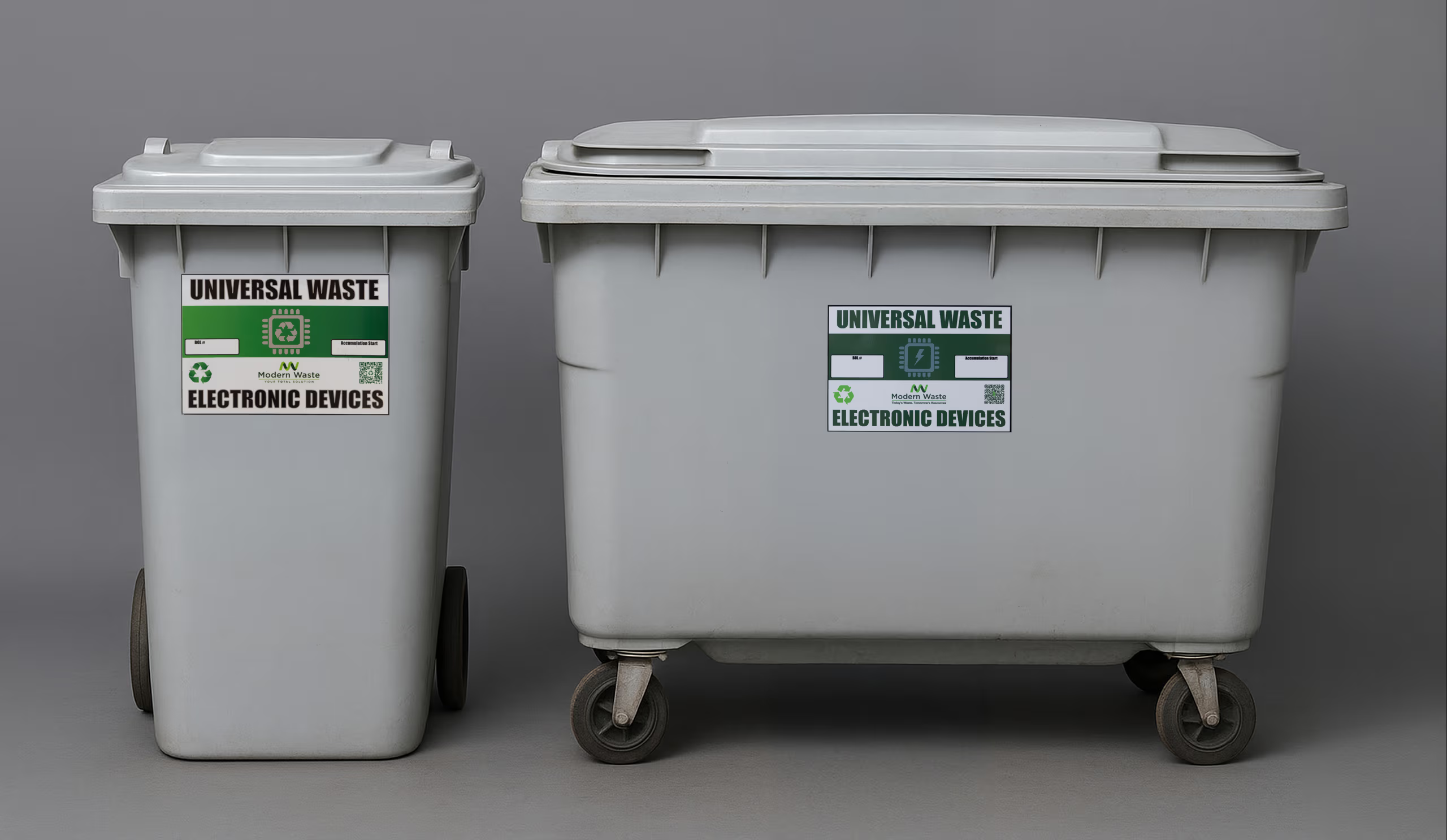
We provide clearly labeled, tamper-resistant containers to ensure safe and compliant collection of electronic waste and batteries at your location.

Modern Waste Solutions has served businesses and communities across California with dependable, environmentally responsible recycling solutions for over two decades.
We adhere to all California and federal regulations, ensuring your electronic and battery waste is managed with complete transparency and environmental responsibility.

Reviews
A little bit off the beaten track in Natomas, but Modern Waste quickly and efficiently helped me recycle my broken Lithium Iron Phosphate batteries at a reasonable $/lb fee (Sac county e-waste will not accept these items). Ramiro and Vincent were very friendly and helpful.

Chris was awesome! He came in and picked up all of the e-waste we had ready for him. He was polite and professional throughout the entire process. He handled the equipment with care, including the site equipment that was already in place. I am very happy with his service and appreciate the great job he did.

Aaron and Vincent were awesome, excellent customer service!

Great guys, excellent customer service, highly recommend!

Polite, quick and easy.

Chris from modern waste was the most outstanding respectful person I ever met my life when he was done he offered to sweep the floors. He offered so much even though he was limited on time he went out of his way and he’s over beyond best guy I ever met thank you so much for your service services Dan ITG.


Data center decommissioning is a controlled change project that retires workloads, infrastructure, and records without interrupting systems that must remain live. Here is the full process, from go/no-go to final reconciliation.
A mature ITAD program connects asset ownership, data security, environmental compliance, logistics, financial recovery, and reconciliation. Here is how the process works, what it costs, and how to evaluate a provider.

IT equipment liquidation converts marketable retired assets into documented financial recovery while routing nonmarketable equipment to responsible recycling. Here is how to decide which path fits each asset.