

Published April 30, 2025 · 5 min read · Updated September 27, 2026
How to Set Up an E-Waste Collection Point at Your Business
Where to put an e-waste collection point, which containers and labels it needs, how to keep it from overflowing, and how to get staff to use it.
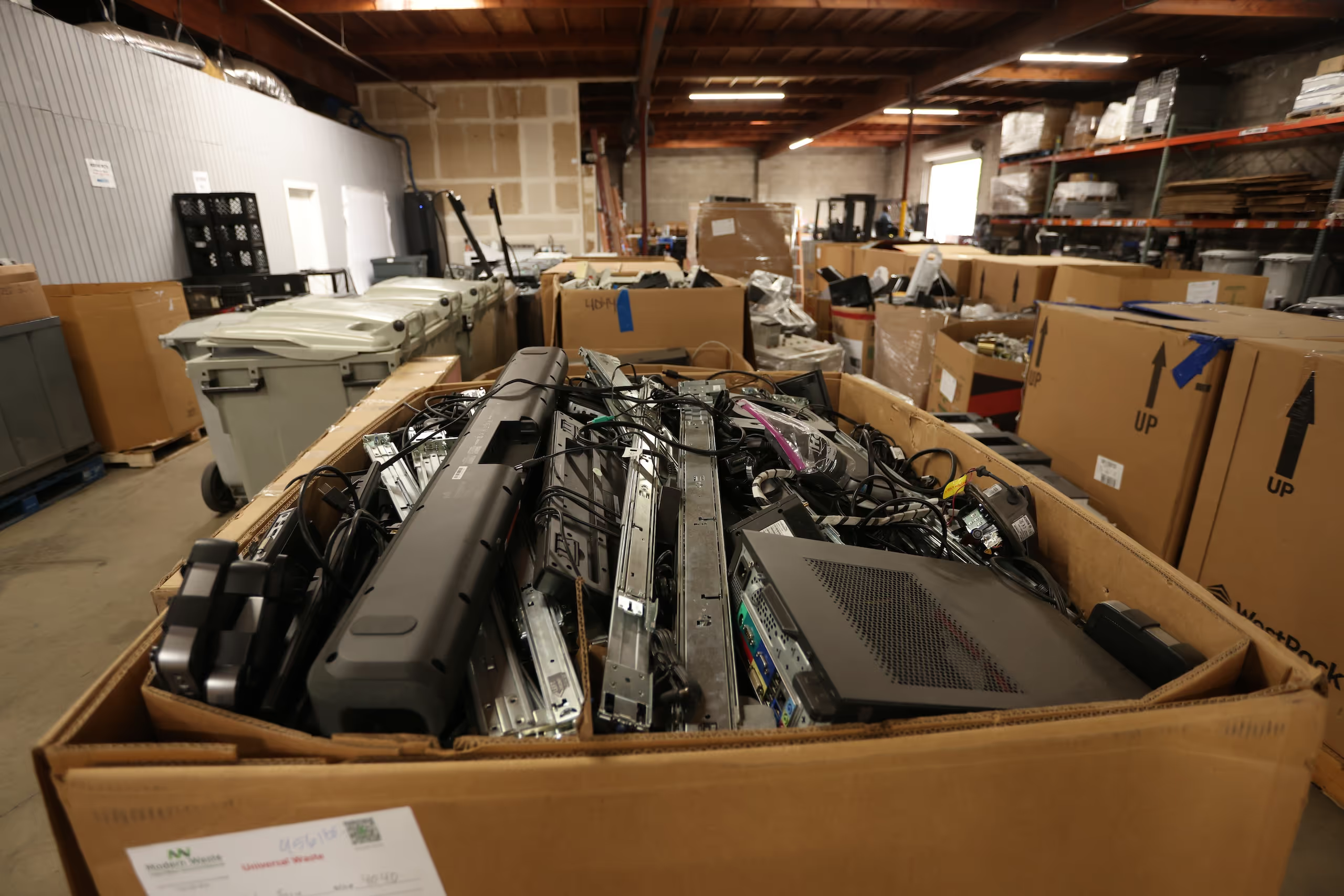
E-waste rarely arrives all at once. A keyboard here, a dead phone there, a UPS battery swapped out on a Friday afternoon. Without one designated place to put it, it ends up in closets, under desks, in the back of a truck on a job site, or in the trash. An e-waste collection point gives every retired device one destination and gives the business a single place to check before pickup.
Modern Waste Solutions has operated since 1999 from its Sacramento facility and supplies containers, pickups and recycling records to organizations throughout California. This guide covers where to put an e-waste collection point, what containers and labels it needs, how to keep it from running out of space, and how to get people to use it.
Any site that retires electronics or batteries more than a few times a year. Offices collect phones, laptops, peripherals and toner-stained printers. Warehouses and plants add scanners, forklift and UPS batteries, and control equipment. Construction sites produce tool batteries, radios, temporary lighting and whatever electronics come out of a building during demolition. Larger organizations usually need one main collection point per building plus small battery containers in departments that go through a lot of them.
A good spot is easy for staff to reach and easy for a pickup crew to load from. Look for:
- An indoor or covered area, so rain doesn't reach batteries or circuit boards.
- A short, level path to a loading dock, freight elevator or parking area.
- Distance from exits, heat sources and anything flammable, since lithium batteries can ignite if damaged.
- A way to lock it, or at least keep data-bearing devices out of public reach.
- Enough floor space that the area never blocks an aisle or an exit route.
On a job site, the collection point is often a lockable job box or a caged corner of a conex container. The same rules apply: dry, secured and away from fuel and hot work.
Mixing everything in one bin is where most problems start. Batteries of different chemistries shouldn't share a container, and hard drives shouldn't sit in an open bin with old keyboards. We provide containers sized to each material stream:
| Material | Typical container | Handling note |
|---|---|---|
| Office electronics and peripherals | E-waste bin or caster cart | Leave batteries inside devices unless they are damaged |
| Bulk equipment, monitors, servers | Gaylord box or metal cage | Keep CRTs upright and screens intact |
| Alkaline batteries | Alkaline battery bucket | Keep separate from rechargeable chemistries |
| Lithium-ion and lithium primary batteries | Lithium battery bucket or drum | Tape terminals or bag individually |
| Lead-acid and UPS batteries | Lead battery tub or banded pallet | Store upright on an acid-resistant surface |
| Fluorescent lamps | Mixed lights tub or lamp box | Keep lamps whole so they don't release mercury |
| Hard drives and other data-bearing media | Locked container | Keep a count; destroy with a certificate |
Swollen, cracked or leaking batteries don't go into any of these. Set them aside in a separate container, away from other material, and call for handling instructions. Our article on battery storage safety covers damaged cells.
Most of what lands in a collection point is universal waste under DTSC rules. That comes with a few requirements for the business holding it:
- Label each container with the words "Universal Waste" and the type of waste inside, such as batteries, lamps or electronic devices.
- Mark the accumulation start date: the date the first item went in.
- Ship the material to an authorized handler or recycler within one year of that date.
- Train the people who handle the containers, and keep records of the training and each shipment.
DTSC publishes a blank universal waste label with fields for contents, accumulation start date and shipper address. Our guide to universal waste management explains the handler rules in more detail.
Space is the complaint we hear most. A collection point that overflows turns back into a storage closet, and material left there too long runs into the one-year limit. Three habits keep it under control:
- Size the pickup to the fill rate. Watch how long the first container takes to fill, then set a recurring pickup a little faster than that.
- Set a call-in trigger. When a container is three-quarters full, the person responsible requests a pickup. Don't wait for the next scheduled visit.
- Plan for spikes. A laptop refresh, a lighting retrofit or a site closeout will produce more than months of normal use. Book a one-time pickup for those.
Small and mid-size sites often do best on a route-based business recycling pickup, where a truck visits on a set schedule. For a one-time load between visits, use our schedule a pickup form.
People use a collection point when they know it exists and the rules fit on one sign. Put a short list with pictures on the wall: what goes in each container, what never goes in (food waste, chemicals, paint, aerosol cans with product still inside), and who to call about a damaged battery. Tell IT and facilities staff first, since they retire the most equipment. When contractors work on site, include the collection point in their site orientation so their retired equipment doesn't leave in a roll-off bin.
How often should an e-waste collection point be emptied?
Often enough that no container reaches its one-year accumulation limit and none overflow. Most offices settle on monthly or quarterly pickups, with extra pickups for refresh projects.
Can batteries go in the same bin as electronics?
Batteries built into devices can stay in them if they are intact. Loose batteries go in separate containers sorted by chemistry, with lithium terminals taped.
Should hard drives go in the general e-waste bin?
No. Keep drives and other data-bearing devices in a locked container with a running count, and have them wiped or destroyed with a certificate.
Who supplies the containers?
We provide e-waste bins, caster carts, gaylord boxes, cages and battery buckets as part of a pickup program, sized to the material and volume at your site.
An e-waste collection point works when it is in the right place, split into the right containers, labeled with a start date, and emptied before it overflows. Get those four things right and retired equipment stops piling up in closets and dumpsters. Request a quote and we will size containers and a pickup schedule for your site, or read about our business electronics recycling and battery recycling services.
- California DTSC: Universal Waste Handlers
- California DTSC: Universal waste label template (PDF)
- CalRecycle: Wastes Banned From the Trash
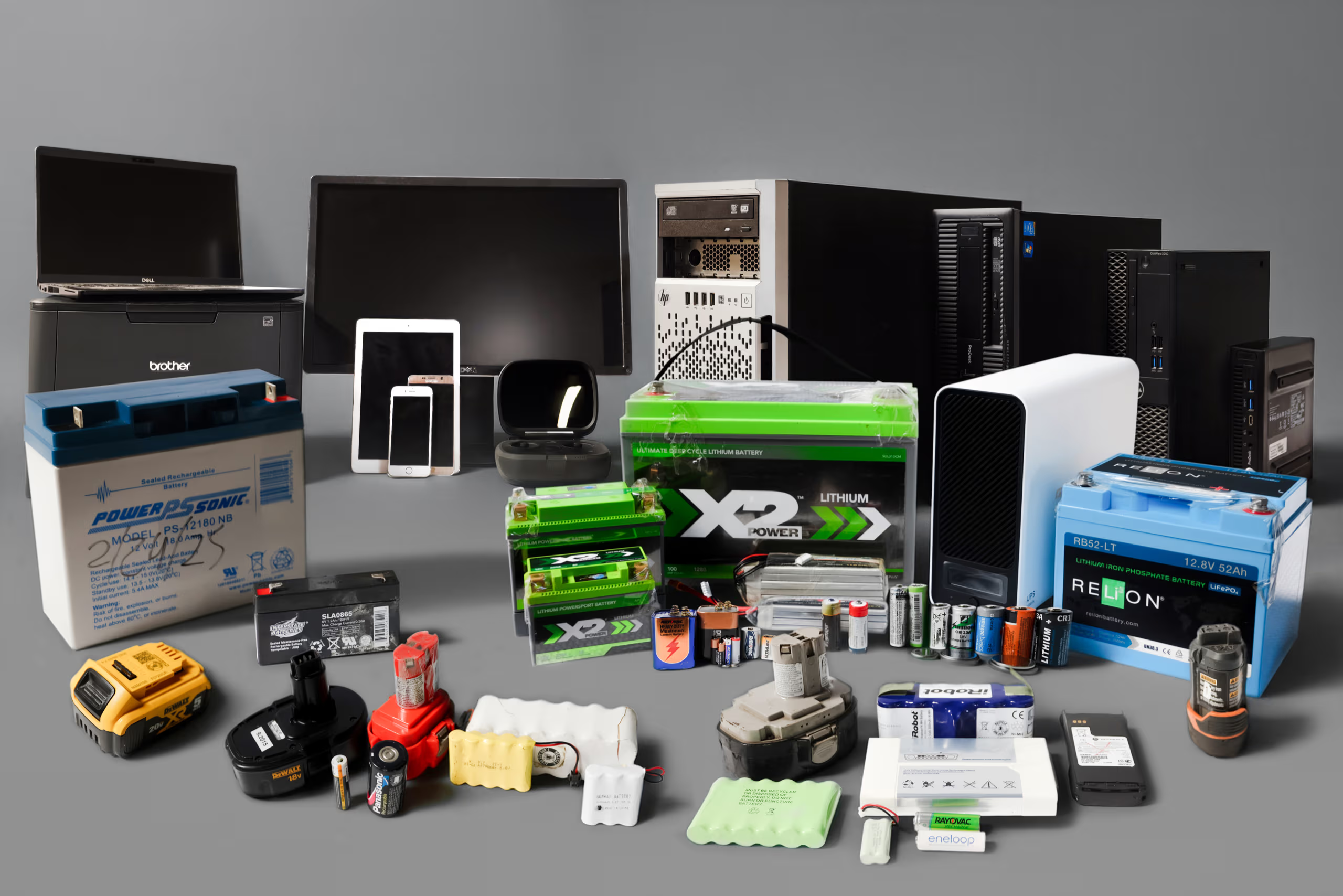

Simplify your compliance and disposal process with bundled recycling services that handle both electronic devices and batteries in one streamlined solution.

Our scheduled, route-based pickups cover all major regions of California—ensuring efficient, on-time service no matter where you operate.
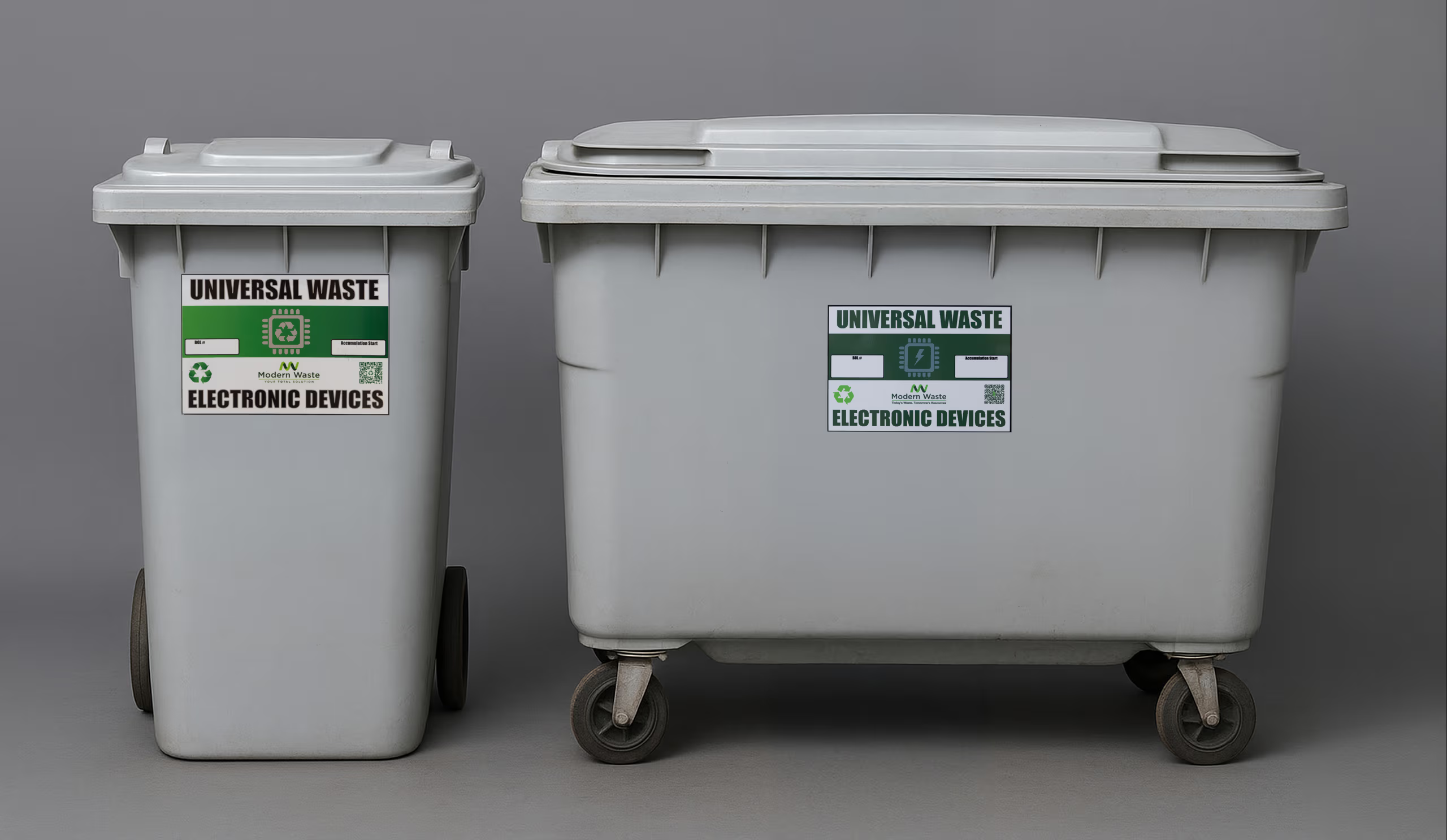
We provide clearly labeled, tamper-resistant containers to ensure safe and compliant collection of electronic waste and batteries at your location.

Modern Waste Solutions has served businesses and communities across California with dependable, environmentally responsible recycling solutions for over two decades.
We adhere to all California and federal regulations, ensuring your electronic and battery waste is managed with complete transparency and environmental responsibility.



Reviews
A little bit off the beaten track in Natomas, but Modern Waste quickly and efficiently helped me recycle my broken Lithium Iron Phosphate batteries at a reasonable $/lb fee (Sac county e-waste will not accept these items). Ramiro and Vincent were very friendly and helpful.

Chris was awesome! He came in and picked up all of the e-waste we had ready for him. He was polite and professional throughout the entire process. He handled the equipment with care, including the site equipment that was already in place. I am very happy with his service and appreciate the great job he did.

Aaron and Vincent were awesome, excellent customer service!

Great guys, excellent customer service, highly recommend!

Polite, quick and easy.

Chris from modern waste was the most outstanding respectful person I ever met my life when he was done he offered to sweep the floors. He offered so much even though he was limited on time he went out of his way and he’s over beyond best guy I ever met thank you so much for your service services Dan ITG.


Data center decommissioning is a controlled change project that retires workloads, infrastructure, and records without interrupting systems that must remain live. Here is the full process, from go/no-go to final reconciliation.
A mature ITAD program connects asset ownership, data security, environmental compliance, logistics, financial recovery, and reconciliation. Here is how the process works, what it costs, and how to evaluate a provider.
IT equipment liquidation converts marketable retired assets into documented financial recovery while routing nonmarketable equipment to responsible recycling. Here is how to decide which path fits each asset.