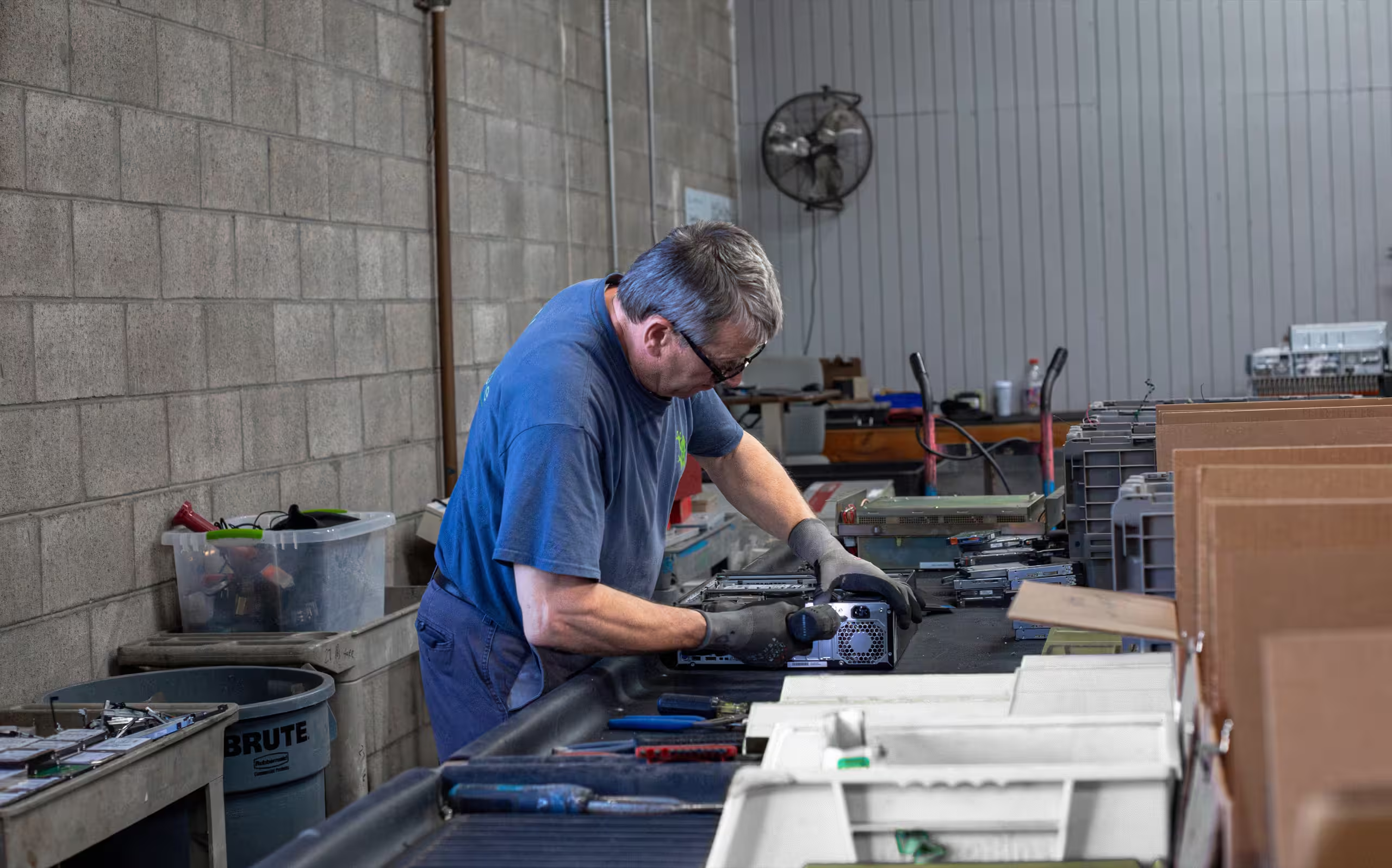


For many businesses, the documents are what they actually need from a recycling vendor. A certificate is what you can show an auditor, a client or a regulator if your disposal practices are ever questioned. Reports are step six of our six-step program, and they close out every pickup.
Every pickup is tracked, categorized, processed and documented. For each set of materials we receive, we:
- categorize and process the items by type
- issue matching certificates of destruction or recycling
- provide a report of what was received and processed
The documents depend on the service. A closeout can include:
| Document | What it records | When it's issued |
|---|---|---|
| Certificate of recycling | General equipment, batteries or other material that was collected and routed to recycling | After recycling pickups, including battery pickups |
| Certificate of destruction | Data-bearing devices that were destroyed, documented by serial number, quantity and weight | After hard drive destruction at our facility or shredding at your site |
| Erasure report | Each wiped drive by serial number, with the technique used and the verification result | When drives are wiped for reuse, resale or lease return |
| Receiving and processing report | What was received in the load and how it was processed | With each set of materials |
| Environmental impact summary | How materials were diverted from landfill toward reuse or recovery | Depending on the scope of the project |
That depends on the service tier and on what you set in the scope. Hard drive service tiers range from basic DBAN erasure included with a standard pickup up to DOD 5220.22-M and NIST 800-88 compliant destruction. At that top tier, the certificate of destruction lists the make, model, method and serial number of every drive.
For general equipment, serial-level reporting is available when it's included in the scope, and it depends on an agreed inventory process at pickup. On an ITAD project, certificates of destruction and recycling are tied to your asset list, along with a chain-of-custody record from pickup to processing. Any environmental figures we report are based on documented processing weights.
Our reports and certificates help you:
- show compliance with environmental, legal and data security regulations
- track progress on sustainability goals
- measure your carbon footprint reduction efforts and support ESG reporting
Our hard drive destruction services are built to meet FACTA, HIPAA, PCI DSS, GLBA and Sarbanes-Oxley requirements, along with California's Information Practice Act (SB 1386). The certificate of destruction is the record that ties a specific drive to that process.
A certificate documents a defined process or a completed job. It isn't a blanket guarantee of your organization's legal compliance, and it doesn't replace your own inventory records. Keep certificates on file with the chain of custody from pickup.
All of your reports and certificates are stored in our secure client portal. It keeps past documentation in one central archive, and you can pull up any report or certificate whenever you need it for an audit, ESG reporting or internal tracking.
Reports and certificates are released once processing and reconciliation are complete. A same-day or fixed turnaround applies only when it's written into your approved proposal. If you have an audit, lease return, move or shutdown deadline, tell us at the start so the schedule can be planned back from that date.
- Confirm the report fields, serial numbers and quantities you need in the work order before service starts.
- Reconcile the final report against your release list so every device is accounted for.
- Check that any failed or missing item has its own exception record.
- Raise discrepancies against the pickup ticket before the project closes.
The reports draw on the data logged during tracking and the outcomes recorded during processing, so each document traces back to a specific pickup.